


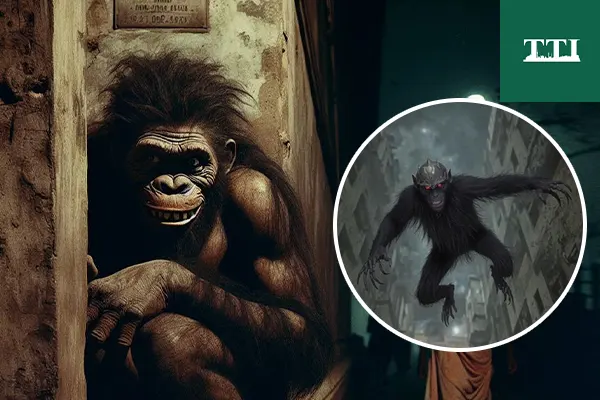
In 2001, Delhi witnessed an unusual wave of fear and fascination when reports of a mysterious creature known as the “Monkey-Man” began to emerge. Unlike typical myths rooted in ancient scriptures, this legend developed rapidly in the modern urban context, capturing the imagination of city dwellers and media alike. The Monkey-Man was described as a small, agile humanoid figure with simian features, often sighted at night, causing panic across neighborhoods.
The phenomenon began in late April 2001 when residents of Delhi reported seeing a strange creature in the city’s streets and rooftops. Witnesses described it as a creature approximately four to five feet tall, with sharp claws, glowing eyes, and an uncanny ability to leap across rooftops with incredible speed. Some even claimed it could cling to walls and evade capture with supernatural agility. The fear escalated as people recounted encounters of scratches, unexplained injuries, and even sensations of being watched while walking home at night.
Media Sensation and Public Panic
The Monkey-Man sightings quickly became a sensation in local and national media. Newspapers reported daily sightings, often embellishing details from frightened residents, while radio stations encouraged listeners to share their experiences. This mass media coverage played a significant role in transforming the incidents into an urban legend, blending rumor with hysteria. Delhi, already grappling with high population density and social anxieties, became a fertile ground for such panic to flourish.
Interestingly, many reports shared common elements despite the vast number of witnesses. The creature was consistently described as small, with fur covering its body and an almost human-like face. It appeared predominantly at night, leaping from rooftops and sometimes peering through windows. The accounts of scratches or injuries caused by the creature added a physical dimension to the legend, heightening fear among residents. Over time, some people began taking precautionary measures, such as patrolling rooftops at night or carrying sticks to fend off the creature.
Psychological and Sociological Perspectives
Experts in psychology and sociology later examined the Monkey-Man phenomenon as a case of mass hysteria or collective delusion. The fear spread rapidly, fueled by media reports and the human tendency to seek explanations for unexplained events. Psychologists suggested that stress, anxiety, and rumors might have amplified ordinary nocturnal sightings or natural events, transforming them into evidence of a supernatural being.
Some researchers proposed that the Monkey-Man legend reflected underlying social anxieties in Delhi at the time. The city, dealing with rapid urbanization, crime, and a complex social landscape, provided fertile ground for a mysterious figure to symbolize collective fears. The Monkey-Man became a scapegoat, a tangible representation of uncertainties and insecurities within the urban environment. In essence, the creature allowed people to externalize their fears, projecting them onto a mythic being.
Also Read: Spilling Milk in Indian Culture: Meaning, Beliefs, and Symbolism
Cultural Impact and Legacy
Beyond the immediate panic, the Monkey-Man of Delhi left a lasting cultural impact. The legend inspired countless discussions online and in newspapers, eventually making its way into popular culture through comic books, films, and local stories. In many ways, it became an Indian equivalent of global urban legends like the Jersey Devil and Mothman, adapted to the context of a modern city.
Local folklore enthusiasts often point out that the Monkey-Man shares traits with mythological simian figures like Hanuman, though in a far more sinister form. Unlike divine or heroic depictions, the Monkey-Man is associated with fear, chaos, and nocturnal mischief. This inversion of the familiar mythological imagery contributed to its eerie appeal, blending traditional symbolism with contemporary urban anxieties.
The legend also prompted discussions about media responsibility in propagating fear. Some journalists admitted that sensational reporting likely exaggerated incidents, contributing to mass panic. At the same time, residents’ accounts underscored how collective belief could shape perception, turning ordinary shadows and noises into evidence of a supernatural entity.
Modern-Day Reflections
Over time, sightings of the Monkey-Man dwindled, and the frenzy gradually subsided, but the legend remains a fascinating chapter in Delhi’s urban folklore. Today, the Monkey-Man serves as a symbol of the intersection between fear, media, and urban life in India. It illustrates how modern cities can generate new mythologies, drawing from both ancient cultural symbols and contemporary anxieties.
The tale of the Monkey-Man continues to be cited in discussions of mass hysteria, urban legends, and cultural psychology. It reminds us that legends are not confined to rural villages or ancient texts; they can emerge anywhere, even amidst the bustling streets of a metropolis like Delhi. For many, the Monkey-Man of 2001 is more than a story of a mysterious creature—it is a mirror reflecting the complexities, fears, and imagination of urban India.
Conclusion
In conclusion, the Monkey-Man of Delhi exemplifies how urban legends evolve in the 21st century, blending eyewitness accounts, media amplification, and social anxieties into a story that captivates collective imagination. While skeptics may dismiss it as a product of fear and rumor, the enduring fascination with the Monkey-Man proves that even modern cities are fertile ground for myths to thrive, echoing the age-old human desire to find mystery in the everyday.
Also Read: Origins of the Nale Ba Legend: A Folkloric Warning in Indian Culture