


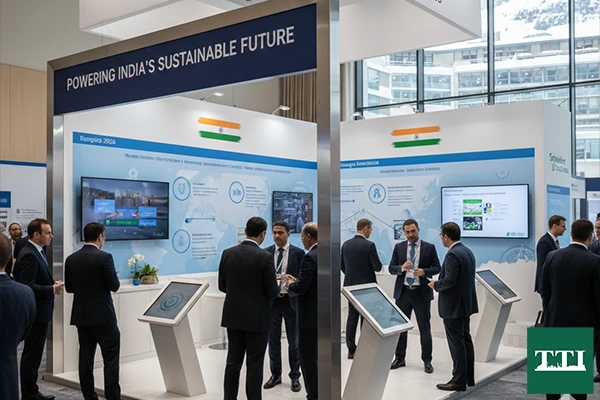
At the World Economic Forum (WEF) 2026 in Davos, Schneider Electric India has emerged as a pivotal player in the global dialogue on industrial transformation. As the world grapples with the dual challenges of economic volatility and climate change, Schneider Electric’s leadership—headlined by Industrial Automation CEO Gwenaelle Avice Huet and India MD & CEO Deepak Sharma—has laid out a bold vision for the future.
This vision centers on a powerful trifecta: Industrial Automation, Artificial Intelligence (AI), and Sustainability. With India positioned as the company’s third-largest market and a global R&D hub, the strategies discussed at Davos 2026 are not just corporate goals—they are a blueprint for the “Industry of the Future.”
The “Local for Global” Strategy: India as an Innovation Hub
One of the standout themes from Davos 2026 is Schneider Electric’s commitment to its “Local for Local” and “Local for Global” hub model. With a workforce exceeding 28,000 employees and over 30 manufacturing plants in India, the company is leveraging Indian talent to solve global problems.
Investing in the Future
Deepak Sharma highlighted an ambitious $370 million (₹3,200 crore) investment plan slated for completion by the end of 2026. This capital is being funneled into:
- Expanding Manufacturing: Adding five new state-of-the-art factories across states like Gujarat, Telangana, and Odisha.
- R&D Excellence: Strengthening India’s role as one of the four global hubs for Schneider Electric, focusing on open software-defined automation.
- Skill Development: Addressing the “Technology Scaling Challenge” by training over 1 million people in energy management.
AI-Powered Industrial Automation: Moving Beyond Experiments
At Davos, Schneider Electric emphasized that industry automation is at a “turning point.” The conversation has shifted from “what AI can do” to “how AI is delivering measurable ROI.”
Agentic AI and Digital Twins
The company introduced the concept of Agentic AI—autonomous systems capable of proactive decision-making. Unlike traditional automation, these AI agents can:
- Optimize cleaning cycles in Food & Beverage (F&B) plants to reduce water waste.
- Predict maintenance needs in heavy industries to eliminate costly downtime.
- Simulate “Digital Twins” of entire factories to test efficiency before a single machine is turned on.
Resource Advisor+ and “Sera”
Schneider Electric launched Resource Advisor+, an AI-first intelligence platform featuring an AI agent named Sera. This tool allows Indian enterprises to unify fragmented energy data into a single “command center,” facilitating faster decarbonization across Scope 1, 2, and 3 emissions.
Read our previous post: Rocky Aur Rani Ki Prem Kahani (2023) – Romantic Comedy Highlight
Sustainability as a Business Imperative
A recurring message from the Schneider delegation was that “Sustainability is good business.” The company is moving away from purely symbolic green initiatives toward Capital and Carbon Efficiency (CCE).
Focus Sectors in India
Schneider Electric is targeting three critical sectors for India’s green transition:
- Green Steel: Supporting the government’s push for sustainable metallurgy through electrification.
- Hydrogen Economy: Providing the automation infrastructure needed to make green hydrogen scalable.
- Water Management: Collaborating with urban bodies, such as the Delhi water industry, to digitize wastewater management and reduce leakage.
“Only 5% of industry heating is electrified today, yet technology exists to reach 60%. It’s about know-how and making it scalable.” — Gwenaelle Avice Huet, CEO of Industrial Automation.
The Role of “Electricity 4.0”
Schneider Electric’s vision for India is built on Electricity 4.0—the convergence of digital and electric. By digitizing the grid and industrial processes, the company believes India can significantly reduce energy intensity.
Strategic Partnerships
The Davos 2026 meeting also saw the first significant convening of the Energy Technology Coalition, led by Schneider Electric in partnership with Bloomberg New Economy. This coalition aims to accelerate the adoption of technologies that make energy consumption more resilient amid soaring demand from AI data centers.
| Key Metric | Target / Status (2026) |
| India Workforce | 28,000+ Employees |
| Net-Zero Operations | Goal by 2030 |
| Investment in India | $370 Million by 2026 |
| Energy Savings | 5-15% via on-device AI |
Conclusion: A Resilient Path Forward
Schneider Electric’s participation at Davos 2026 underscores India’s importance in the global industrial landscape. By combining AI-driven automation with a steadfast commitment to sustainability, the company is helping Indian industries move from being “IP consumers” to “IP creators.”
As we look toward the remainder of 2026, the focus remains clear: scaling technology, upskilling the workforce, and ensuring that every kilowatt of energy is used with maximum intelligence.
Also read: Operation Sindoor: How the Indian Army Exposed Pakistan’s AI-Driven Digital War