


The Minimum Support Price (MSP) system is a cornerstone of India’s agricultural policy, designed to ensure fair returns for farmers and stabilize agricultural markets. Introduced by the government as a mechanism to protect farmers from price volatility, MSP guarantees a fixed price for certain crops, even if market prices fall below this threshold. While MSP has contributed to food security and rural livelihoods, it has also faced criticism for inefficiencies, limited coverage, and market distortions. Understanding the benefits and limitations of MSP is essential for farmers, policymakers, economists, and stakeholders in India’s agriculture sector. This article explores the MSP system in India, its objectives, benefits, challenges, and potential reforms for a sustainable agricultural economy.
Understanding the MSP System
The Minimum Support Price is the price at which the government purchases crops from farmers to ensure they receive a fair return for their produce. The Food Corporation of India (FCI), state agencies, and other authorized procurement agencies implement this program. MSP applies to crops like rice, wheat, pulses, oilseeds, cotton, sugarcane, and certain minor cereals, although coverage varies across years.
MSP is announced before the sowing season, providing farmers with guidance on the expected price for their crops. It acts as a safety net against price fluctuations in open markets, which can result from surplus production, seasonal demand variations, or external factors such as global commodity prices.
The pricing process considers several factors, including the cost of production, market trends, input costs, crop yield, and the need to incentivize crop diversification. The Commission for Agricultural Costs and Prices (CACP), an expert body under the Ministry of Agriculture, recommends MSPs annually to ensure farmers’ welfare while maintaining market stability.
Benefits of the MSP System
The MSP system has been widely credited with supporting Indian agriculture and rural livelihoods in multiple ways:
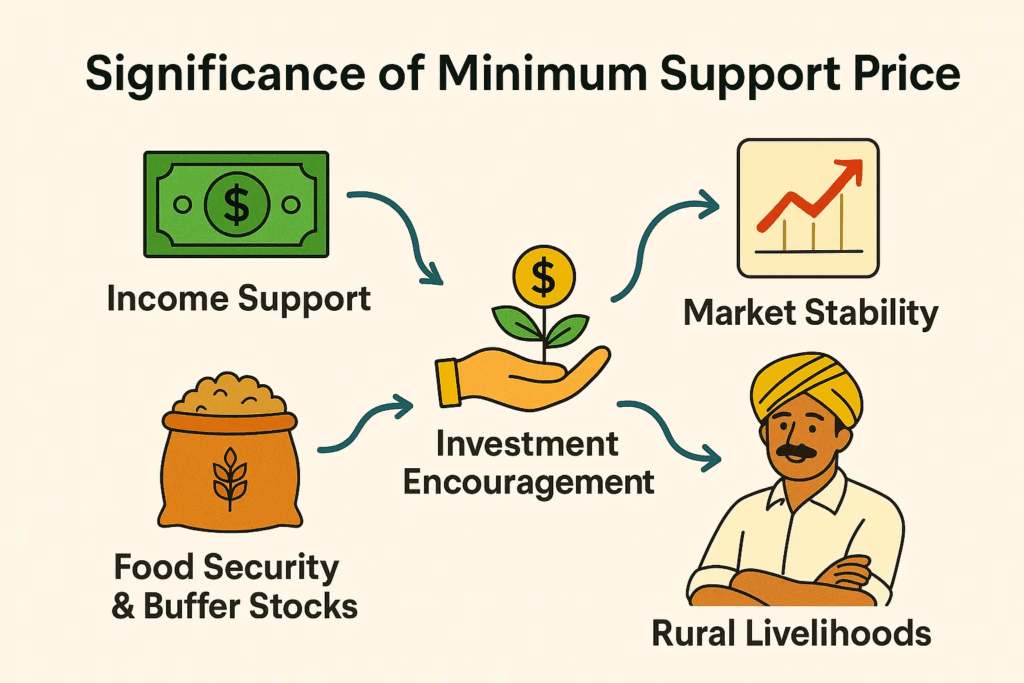
Ensuring Price Stability
MSP provides a guaranteed floor price for farmers, protecting them from sudden market collapses. For instance, during years of bumper harvests, market prices may drop sharply due to excess supply. MSP ensures farmers can sell at a reasonable price, preventing distress sales and financial losses. This stability encourages farmers to continue cultivating essential crops, supporting national food security.
Promoting Agricultural Production
By guaranteeing returns, MSP incentivizes farmers to grow crops that are crucial for domestic consumption and export. Rice and wheat, staples of India’s food system, are heavily influenced by MSP procurement. This policy helps maintain consistent production levels, ensuring adequate food availability for the population and stabilizing supply chains.
Supporting Farmer Incomes
MSP supplements farmers’ income, particularly small and marginal farmers who may lack bargaining power in local markets. By selling at MSP through government procurement agencies, farmers are assured of a minimum income, helping reduce rural poverty and improving livelihoods.
Encouraging Modernization and Investment
The assurance of a minimum price allows farmers to invest in better seeds, fertilizers, irrigation, and equipment, improving productivity. Over time, MSP contributes to agricultural modernization, enabling higher yields and efficient farming practices.
Enhancing Food Security
MSP facilitates procurement for government stockpiles used under public distribution systems (PDS). This ensures affordable food grains for vulnerable populations while stabilizing national food reserves, mitigating the impact of shortages or price spikes.
Limitations of the MSP System
Despite its advantages, the MSP system faces significant challenges that limit its effectiveness:
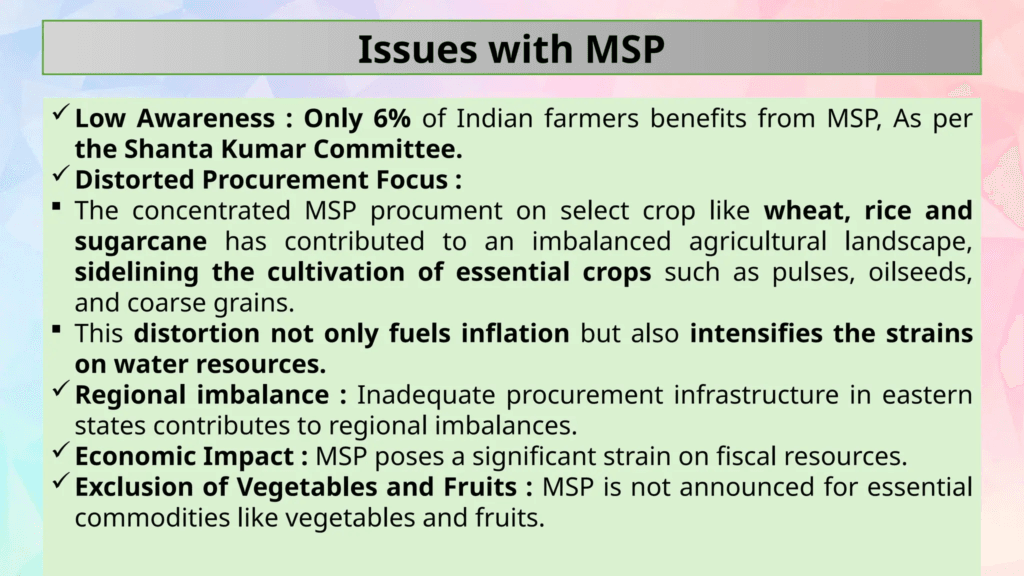
Limited Coverage
MSP benefits are concentrated on a few major crops like rice, wheat, and select pulses. Many farmers cultivating fruits, vegetables, or minor cereals do not benefit from MSP, limiting its impact on income support and crop diversification. Smallholder farmers often grow crops outside the MSP list, leaving them vulnerable to market volatility.
Procurement Inefficiencies
Government procurement infrastructure is often concentrated in specific states like Punjab, Haryana, and Madhya Pradesh. Farmers in remote regions may face difficulties accessing MSP markets, encountering delays, bureaucratic hurdles, or low procurement volumes. This creates geographical disparities in the effectiveness of MSP.
Market Distortions
Guaranteed MSPs can distort market dynamics by incentivizing overproduction of certain crops. For example, heavy procurement of wheat and rice has led to surplus stocks, putting pressure on storage infrastructure and contributing to food wastage. At the same time, crops with lower MSP coverage remain underproduced, affecting dietary diversity and rural income potential.
Fiscal Burden on the Government
Procurement at MSP requires significant government expenditure, including purchasing, storage, transportation, and distribution costs. Sustaining large-scale MSP procurement over time strains public finances, especially when market prices are high or storage facilities are insufficient.
Risk of Distorted Crop Patterns
MSP-driven incentives may encourage monoculture or overemphasis on specific crops, reducing crop diversity and environmental sustainability. Excessive rice and wheat cultivation in certain regions has contributed to groundwater depletion, soil degradation, and ecological imbalances.
Potential Reforms for MSP Effectiveness
To improve the MSP system and enhance benefits for farmers while minimizing drawbacks, several reforms are being discussed and implemented:
Expanding Crop Coverage
Including a broader range of crops such as pulses, oilseeds, and coarse cereals can support smallholder farmers and promote crop diversification. This would reduce dependency on rice and wheat, improve soil health, and strengthen rural income sources.
Enhancing Procurement Infrastructure
Improving access to MSP markets in remote regions, streamlining procurement processes, and leveraging technology can ensure fair and timely payments for all farmers. Digital platforms, e-NAM (National Agriculture Market), and mobile-based procurement can reduce inefficiencies.
Market-Linked Pricing
Gradually linking MSP with market prices and crop-specific demand can reduce overproduction of certain staples while incentivizing underproduced crops. Market-linked MSP can promote balanced agricultural growth and sustainable farming practices.
Private Sector Participation
Encouraging private players to participate in MSP procurement can increase competition, reduce storage bottlenecks, and ensure timely payments. Public-private collaboration can enhance efficiency and broaden market reach for farmers.
Risk Management Tools
Complementing MSP with crop insurance, futures markets, and financial instruments can protect farmers from climate risks, market volatility, and unforeseen events. Integrated approaches can provide comprehensive income security without over-reliance on MSP alone.
Conclusion
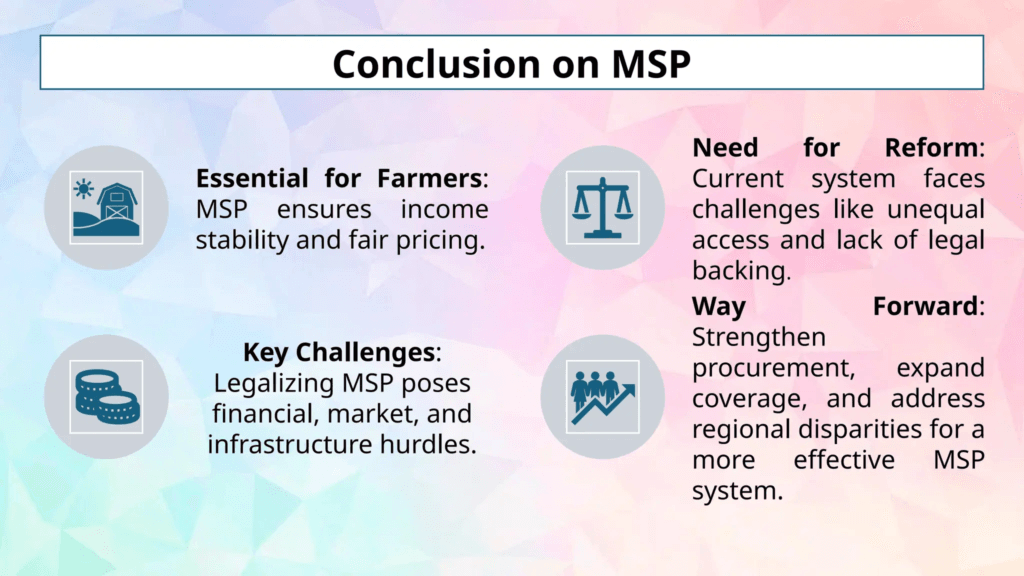
The MSP system is a vital component of India’s agricultural policy, providing price stability, income support, and food security while promoting productivity and modernization. It has significantly benefited farmers of staple crops and contributed to national economic development. However, limitations such as limited crop coverage, procurement inefficiencies, market distortions, fiscal pressures, and environmental concerns highlight the need for reforms.
Expanding MSP coverage, improving procurement infrastructure, linking prices with market dynamics, encouraging private sector participation, and introducing complementary risk management tools can enhance the system’s effectiveness. By addressing these challenges, India can ensure that MSP continues to support farmers’ livelihoods, promote sustainable agriculture, and strengthen food security for the nation.
FAQs
- What is MSP and how does it work?
MSP is the minimum price at which the government buys crops from farmers to ensure fair returns, announced before the sowing season for select crops. - Which crops are covered under MSP?
Rice, wheat, pulses, oilseeds, cotton, and certain cereals are included, although coverage varies annually. - What are the main benefits of MSP?
MSP ensures price stability, supports farmer incomes, promotes agricultural production, encourages modernization, and enhances food security. - What are the key limitations of MSP?
Limitations include limited crop coverage, procurement inefficiencies, market distortions, fiscal burden, and risk of distorted crop patterns.
Next Topic: Infrastructure Financing Models Used in India
Also Check: Infrastructure Assets as Long-Term Investments in India