


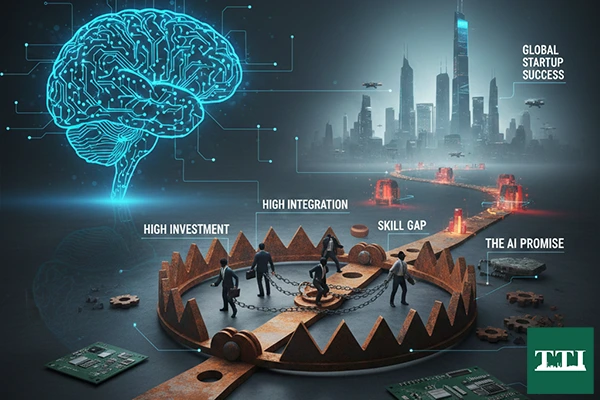
In the rapidly evolving economic landscape of 2026, India’s Micro, Small, and Medium Enterprises (MSMEs) stand at a critical crossroads. Contributing nearly 30% to the nation’s GDP and employing over 110 million people, these businesses are the undisputed backbone of the economy. However, a silent predator—the “Startup Trap”—is causing many promising ventures to plateau or face bankruptcy.
The trap isn’t a lack of hard work; it’s a lack of strategic scaling. By leveraging Artificial Intelligence (AI) as a “financial co-pilot,” MSMEs can transition from survival mode to sustainable, data-driven growth.
1. Understanding the “Startup Trap” in the MSME Sector
The “Startup Trap” or “Stagnation Trap” occurs when a business grows to a certain point and then hits an invisible ceiling. For many Indian MSMEs, this happens when the founder remains the sole decision-maker, and operations rely on intuition rather than data.
Common Signs of Stagnation:
- Revenue Plateaus: Sales remain flat for 12–24 months despite increased effort.
- Founder Over-involvement: The business grinds to a halt if the owner is away for a week.
- Fragmented Data: Financials are scattered across Tally, Excel sheets, and WhatsApp messages.
- Referral Dependency: There is no structured pipeline for acquiring new customers.
2. AI as a Financial Co-Pilot: Beyond the Buzzwords
For an MSME, AI is not about building robots; it’s about democratizing intelligence. Traditionally, only large conglomerates could afford the data analysts required to predict market shifts. Today, AI tools allow a small shop owner to gain the same insights via simple, natural language queries.
Predicting Cash Flow and Managing “Burn Rate”
Most businesses don’t fail due to a lack of customers; they fail because they run out of cash. AI-driven financial tools can track receivables, automate expense classification, and—most importantly—predict potential shortfalls before they happen.
Key Insight: Tools like the Net Burn Rate Calculator turn guesswork into data-driven clarity, telling a founder exactly how many months of “runway” they have left before liquidity runs dry.
3. How AI Helps MSMEs Avoid Bankruptcy
In the cut-throat Indian market, the margin for error is slim. AI provides a safety net by automating the “boring but critical” tasks that often lead to human error and financial leaks.
Automating Workflows and Reducing Costs
MSME proprietors often spend up to 50% of their time managing day-to-day administrative functions. AI can reduce operational costs by up to 20% by automating:
- Invoice Processing: Reducing errors in billing and payment tracking.
- Inventory Management: AI predicts demand patterns, ensuring capital isn’t locked up in unsold stock.
- Fraud Prevention: Real-time pattern recognition identifies fraudulent transactions before they settle, a must-have for businesses shifting to digital payments.
4. Scaling Smarter: The 5-Step AI Adoption Blueprint
Scaling “smarter” means focusing on efficiency over speed. Here is a roadmap for Indian MSMEs looking to integrate AI without breaking the bank:
Step 1: Identify the Bottlenecks
Don’t adopt AI because it’s trendy. Identify where you are losing time. Is it customer support? Is it drafting proposals? Start with one high-impact area.
Step 2: Use Accessible Tools
You don’t need a custom-built AI. Start with “AI Co-pilots” already integrated into software you use, such as Google Workspace (Gemini) or Microsoft 365. For finance, look at automated platforms like Zoho Books or RazorpayX.
Step 3: Focus on Upskilling, Not Replacing
The goal of AI is to make your team more productive, not to replace them. Treat AI as an “intern” that handles the grunt work, freeing your staff to focus on customer relationships and strategy.
Step 4: Leverage Alternative Credit Scoring
India’s MSME sector is credit-starved. AI can bridge the $530 billion credit gap by analyzing alternative data—like GST records and digital transaction histories—to help businesses secure loans that traditional banks might reject.
Step 5: Measure and Iterate
Track your results. Did AI-driven marketing increase your leads by 15%? Did automated inventory reduce waste? Use this data to justify further investment.
5. Building for the Long Term: Sustainable Growth Strategies
Sustainable growth is about resilience. In the current “Industry 5.0” era, human creativity must pair with machine efficiency.
Diversification and Market Access
With initiatives like the Open Network for Digital Commerce (ONDC), MSMEs can use AI to optimize their presence on digital marketplaces, reaching Tier II and Tier III cities without a massive marketing budget.
Predictive Maintenance in Manufacturing
For MSMEs in the manufacturing sector, AI-driven predictive maintenance can reduce machine downtime by up to 50%. By knowing when a part is about to fail, you prevent catastrophic production halts.
Conclusion: From Survivors to Architects
The AI revolution is not a distant future; it is a present-day imperative. For India’s MSMEs, the choice is clear: continue with manual, intuition-based processes and risk the “Startup Trap,” or embrace AI as a partner to build a transparent, scalable, and bankruptcy-proof business.
By 2027, AI adoption in this sector could unlock over $500 billion in economic value. The tools are available, the data is ready, and the path to sustainable growth is now powered by intelligence.