


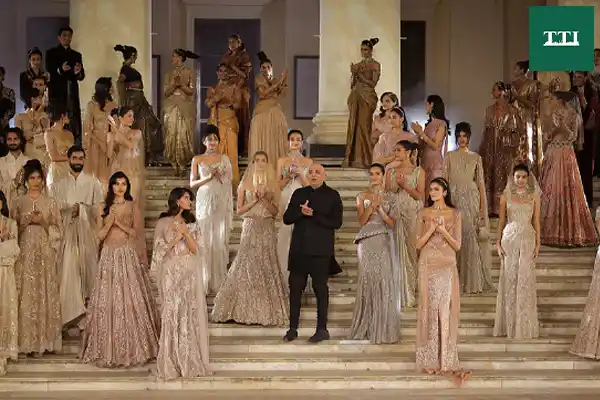
30 years into a career that has redefined the landscape of Indian sartorial identity, Tarun Tahiliani remains as vital and visionary as ever. Often referred to as the “Karl Lagerfeld of India,” Tahiliani’s journey is not just a chronicle of a brand, but a narrative of a nation’s evolving relationship with its own craft. His recent milestone celebration at the British Residency in Hyderabad served as a poignant reminder that while trends flicker and fade, the “Midas touch” of a master lies in the ability to make tradition feel like the ultimate future.
The Architect of “India Modern”
When Tarun Tahiliani first entered the scene in the late 1980s, the concept of a “fashion designer” in India was in its infancy. Coming from a business background at Wharton and having briefly worked in oil-field equipment, Tahiliani’s entry into the world of aesthetics was driven by a desire to see Indian garments treated with the same structural integrity as Western couture. Along with his wife Sailaja and the late Rohit Khosla, he founded Ensemble in 1987, the first multi-designer boutique in India. This was the spark that ignited an industry.
Tahiliani’s signature “India Modern” philosophy was born from a refusal to see Indian fashion as merely costume. He famously sought to marry the fluid, emotive drape of the sari and dhoti with the precision of European tailoring. Over three decades, he has perfected this alchemy, ensuring that the heavy bridal lehenga or the intricate drape of a sari does not wear the woman, but rather moves with her.
Also Read: Smooth Skin Secrets: A Complete Guide to Using Exfoliating Gloves Safely
A Master of the Drape
If there is one element that defines Tahiliani’s 30-year legacy, it is the drape. His fascination with how fabric interacts with the human form has led to revolutionary innovations, such as the pre-stitched sari. By applying the principles of corsetry and structure to traditional Indian silhouettes, he liberated women from the struggle of complicated pleating while maintaining the garment’s soul.
His recent collections continue to push these boundaries. In his 30th-anniversary showcase, there was a visible shift toward “refined elegance” and “bridal ease.” He has moved away from the era of overwhelming ornamentation, focusing instead on weightless fabrics and silhouettes that allow the wearer to breathe and dance. This evolution reflects a designer who is deeply in tune with the modern Indian woman—one who values heritage but demands functionality.
Bridging the Past and Future
Tahiliani’s longevity can be attributed to his role as a bridge-builder. He has spent decades working with handloom clusters and embroidery ateliers, ensuring that age-old techniques are not just preserved as museum pieces but adapted for contemporary life. His work with Chikankari, Swarovski crystals, and digital printing has created a visual language that is uniquely his.
Furthermore, he has successfully expanded his vision beyond the rarefied air of couture. Through his prêt labels and collaborations, like Tasva with the Aditya Birla Group, he is bringing the Tahiliani aesthetic to a wider audience. He has also ventured into interior design and high jewelry with TT Tijori, proving that his design sensibility is a holistic lifestyle rather than just a garment choice.
The Enduring Legacy of the Midas Touch
What keeps Tahiliani at the top of his game after three decades? It is his relentless curiosity and a humility inherited from his father, Admiral R.H. Tahiliani. Despite his stature, he remains a student of his craft, often stating that the more he learns about India’s textile civilization, the more he realizes there is to explore.
His 30-year milestone was not just a celebration of past hits; it was a statement of intent. By choosing the historic British Residency in Hyderabad—a site of layered histories—for his anniversary show, he underscored his belief that fashion is a form of memory. As he continues to reinterpret tradition with confidence and relevance, Tarun Tahiliani proves that his touch remains as golden as ever, turning every thread into a story of modern India.
Also Read: The Naked Dress: Why We Are Still Obsessed With This Bold Fashion Trend