


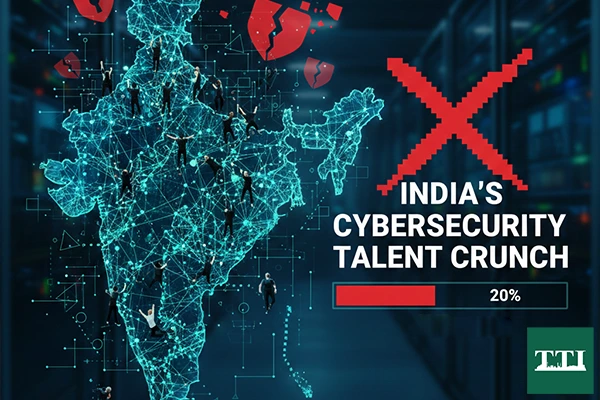
The digital revolution in India has reached an unprecedented scale. As of 2026, the country boasts over 900 million internet users and a thriving digital economy. However, this rapid expansion has exposed a critical vulnerability: a massive shortage of skilled senior cybersecurity professionals.
While the demand for digital safety has skyrocketed, the pool of experts capable of defending India’s critical infrastructure—from power grids to global banking hubs—remains alarmingly shallow. According to recent industry data, India currently faces a talent gap of nearly 650,000 professionals, with the total demand hovering around one million engineers while the current workforce stands at just 350,000.
The AI Paradox: Sophisticated Attacks vs. Reactive Defense
The primary driver behind the urgent need for senior talent is the evolution of threat actors. Artificial Intelligence (AI) has become a “force multiplier” for cybercriminals. Attackers are now using generative AI to automate phishing, create adaptive malware, and conduct “behavior-based” attacks that are significantly harder to detect.
The Rise of Behavior-Based Threats
Data from the Data Security Council of India (DSCI) highlights a startling trend: between 2022 and late 2024, behavior-based cyber threat detections spiked from 13 million to 54 million. This four-fold increase in just two years demonstrates that traditional, signature-based defenses are no longer sufficient.
Senior professionals are needed not just to manage tools, but to architect predictive defense systems that can anticipate these AI-driven maneuvers. As Aditya Verma, a public sector security leader for India and South Asia, notes, the core problem is that cyber defense is inherently reactive, while AI-powered attacks are increasingly proactive and automated.
Why the Senior Talent Gap Persists
Despite competitive salaries and a growing interest in the field, several structural issues prevent India from closing the cybersecurity skills gap.
1. The Dearth of Advanced Skilling Initiatives
While entry-level “boot camps” are common, there is a severe lack of specialized, high-level training. Senior roles in 2026 require expertise in:
- Statistical Applications: Using data science to identify anomalies.
- Cloud Governance: Protecting complex multi-cloud and SaaS environments.
- Zero Trust Architecture: Moving beyond perimeter-based security.
Current academic curricula often lag behind these real-world requirements. Experts argue that cybersecurity education needs to be integrated as early as undergraduate courses to build a foundational mindset of “defense-by-design.”
2. High Pressure and Retention Challenges
The role of a Chief Information Security Officer (CISO) or a senior security architect is one of high stakes and high stress. Nearly 45% of organizations report that high work stress levels contribute to talent attrition. Senior pros are frequently recruited by global firms or “Global Captive Centers” (GCCs) in India, which offer lucrative packages and global exposure, leaving domestic firms and the public sector struggling to retain top-tier talent.
3. The Salary vs. Skill Misalignment
While pay is generally fair—with senior-level engineers (10+ years experience) earning up to ₹60 lakh per annum—the “fairness” of the pay does not solve the lack of qualified candidates. The issue isn’t necessarily the budget; it’s the absence of professionals who possess the specific, high-end technical skills required to earn those salaries.
Critical Sectors Under Fire
The talent shortage is not just a corporate headache; it is a national security concern. Several sectors are particularly vulnerable due to their reliance on legacy infrastructure and the sensitivity of their data.
Vital Infrastructure and Public Systems
Critical assets such as telecom networks, power grids, and government portals are prime targets for state-sponsored actors and hacktivists. Defending these requires “muscle memory” and years of experience—traits often found only in senior professionals.
The Financial and Healthcare Sectors
With the implementation of the Digital Personal Data Protection (DPDP) Act, sectors like Fintech and Healthcare are under immense pressure to comply with new regulations. The demand for Data Protection Officers and Security Auditors has surged, yet many firms find themselves unable to fill these roles, risking heavy fines and operational chaos.
Bridging the Gap: The Path to 2030
To secure India’s digital future, a multi-pronged approach involving the government, academia, and the private sector is essential.
Government and Industry Partnerships
Initiatives like the professional development courses run by Cert-In in partnership with institutions like BITS Pilani are a step in the right direction. However, these programs need to scale significantly to reach the 1-million-professional target.
Rethinking Recruitment and Training
Organizations must move away from simply “hiring for experience” and start “hiring for potential” through:
- Internal Upskilling: Transitioning experienced IT and networking staff into security roles.
- AI-Augmented Defense: Using AI to handle repetitive tasks (like log monitoring), allowing human experts to focus on high-level strategy and threat hunting.
- Standardized Certifications: Creating industry-recognized pathways that align with modern threats like deepfakes and quantum-era risks.
Conclusion
India’s cybersecurity landscape in 2026 is at a crossroads. While the country has the digital ambition to be a global leader, its “shield” is only as strong as the people holding it. The lack of senior cybersecurity professionals is a systemic issue that requires more than just higher salaries; it requires a fundamental shift in how we educate, train, and value the defenders of our digital borders.