


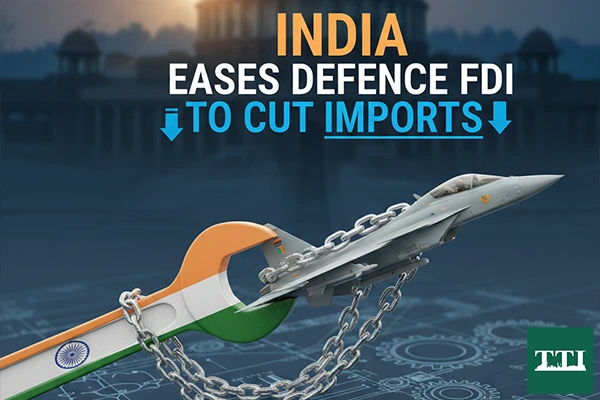
For decades, India has held the undesirable title of one of the world’s largest arms importers. However, a significant policy shift is on the horizon. Recent reports and government discussions suggest that India is preparing to further ease Foreign Direct Investment (FDI) norms in the defence sector. By raising the automatic route cap for existing firms and removing restrictive technology clauses, India aims to attract billions in foreign capital and finally break its cycle of dependence on imported military hardware.
1. The Core of the Reform: Raising the FDI Automatic Route Cap
One of the most critical changes being discussed is the proposal to raise the FDI limit for existing licensed defence companies from 49% to 74% under the automatic route.
Currently, while new companies can enter the market with 74% foreign ownership without prior government approval, existing players—many of whom are involved in crucial joint ventures—have been restricted to a minority 49% stake. This inconsistency has created a “waiting game” for global OEMs (Original Equipment Manufacturers).
Why the 74% Threshold Matters
- Operational Control: Raising the cap to 74% allows foreign companies to have a majority stake, giving them the confidence to bring in proprietary processes and management styles.
- Intellectual Property (IP) Protection: Global giants like Lockheed Martin, Boeing, and Thales are often hesitant to share sensitive technology if they do not have majority control over the entity holding that IP.
- Simplified Compliance: Moving more transactions to the “automatic route” reduces the bureaucratic hurdles and “red tape” associated with seeking Cabinet Committee on Security (CCS) or FIPB-style approvals.
2. Removing the “Modern Technology” Clause
Historically, any foreign investment beyond the automatic cap was only permitted if it resulted in “access to modern technology.” While this sounded good on paper, it became a major bottleneck in practice.
The Ambiguity Problem
The term “modern technology” was never strictly defined. What the Indian government considered “modern,” a foreign firm might consider “standard,” leading to endless negotiations and stalled projects. By removing this vague condition, the government is signaling a shift toward transparency and predictability, which are the two most important factors for long-term institutional investors.
3. Economic Impact: Attracting Billions in Capital
The financial implications of these reforms are staggering. Despite being a massive market, India’s defence sector received only about $26.5 million in FDI between 2000 and late 2025—a tiny fraction of the hundreds of billions that flowed into other sectors like software or telecommunications.
Projections for 2026 and Beyond
- Inflow Estimates: Experts suggest that liberalized norms could attract between $5 billion and $10 billion over the next decade.
- Budgetary Growth: The Ministry of Defence is seeking a 20% increase in the FY26/27 budget over the previous $75.36 billion allocation.
- Production Targets: The government aims to nearly double domestic production to $33.25 billion by 2029.
4. Reducing Reliance on Imported Hardware
India currently imports roughly 60-70% of its defence needs. This creates a strategic vulnerability, especially during geopolitical tensions when supply chains can be disrupted.
Indigenization and “Make in India”
By allowing foreign firms to take majority stakes, India is essentially incentivizing them to move their manufacturing bases from Europe or the U.S. to Indian soil. This supports the Atmanirbhar Bharat (Self-Reliant India) initiative in several ways:
- Supply Chain Integration: Foreign OEMs will bring their Tier-1 and Tier-2 suppliers to India, creating a robust local ecosystem.
- Skilled Job Creation: Manufacturing complex systems like fighter jets, submarines, and drones requires high-tech engineering talent, providing a boost to the Indian workforce.
- Export Potential: Relaxed norms for export-oriented units (EOUs) mean India could become a global hub for repairing and supplying military hardware to Southeast Asia and Africa.
5. Challenges and The Road Ahead
While the outlook is positive, several hurdles remain that the government must address to ensure these reforms translate into actual factory floors.
Balancing Security with Openness
The “Press Note 3” regulations, which restrict investments from countries sharing a land border with India (notably China and Pakistan), will remain in place. Maintaining national security while appearing “open for business” is a delicate balancing act.
Infrastructure and Ease of Doing Business (EoDB)
Attracting FDI is not just about changing a percentage in a policy document. Foreign firms require:
- Consistent Policy: Investors fear “flip-flops” in tax or procurement laws.
- Speedy Land Acquisition: Setting up massive defence corridors requires streamlined land and environmental clearances.
- Ancillary Industries: For a foreign firm to build a tank in India, they need local access to specialized steel, electronics, and composites.
Conclusion: A New Era for Indian Defence
The proposed easing of FDI norms is more than just an economic policy; it is a strategic necessity. By removing the 49% “glass ceiling” for existing firms and ditching ambiguous technology requirements, India is positioning itself as a credible alternative to China in the global defence supply chain.
If executed correctly, these reforms will not only save billions in foreign exchange but also ensure that the Indian Armed Forces are equipped with “Made in India” hardware that is second to none.