


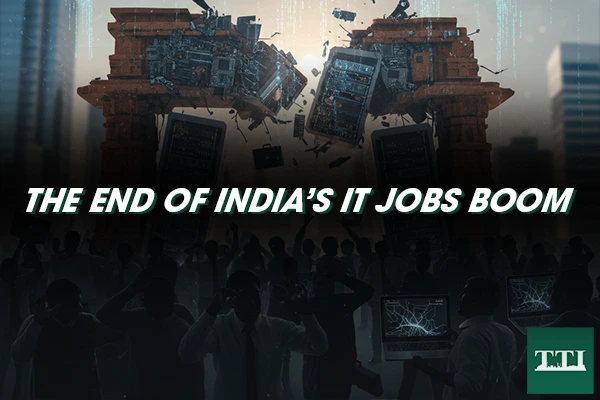
For decades, the Indian Information Technology (IT) sector was the undisputed engine of the nation’s middle-class dream. It was a reliable behemoth that transformed fresh graduates into global professionals, adding tens of thousands of roles to its payroll every quarter. However, the latest industry data reveals a staggering reversal.
As of early 2026, the era of mass recruitment has hit a wall. In a climate defined by client cost-cutting and the rapid integration of Artificial Intelligence (AI), the focus has shifted from “manpower volume” to “skill depth.”
The Numbers Behind the Hiring Collapse
The statistics are nothing short of a “staggering reversal.” In the first nine months of the current financial year, India’s top five IT giants—including TCS, Infosys, and Wipro—collectively added just 17 net employees.
To put that into perspective, during the same period only a year ago, those same firms added nearly 18,000 jobs. In 2016, a single firm like Tata Consultancy Services (TCS) was known to hire 60,000 people in a year. Today, the landscape is unrecognizable.
A Structural Shift, Not a Crisis
While the “hiring freeze” sounds like a sector in crisis, industry experts argue it is a structural evolution. According to Pareekh Jain, CEO of Pareekh Consulting, net new hiring will remain marginal because companies are moving toward a stable headcount model. The goal is no longer to grow the army of workers, but to optimize the one they already have.
Why the Boom Ended: The AI and Automation Catalyst
The primary driver behind this shift is the “civilizational” impact of Generative AI. For years, the IT service model relied on large teams for routine tasks like software testing, maintenance, documentation, and basic coding.
The 20-80 Flip
Historically, the IT delivery model was roughly 80% human-led and 20% technology-assisted. Today, we are seeing a flip toward a model where machines handle the bulk of the manual “grunt work.”
- Automation of Routine Tasks: AI tools are now handling between 20% and 40% of technical work in India’s broader tech sector.
- Client Demands: Global clients are no longer looking for long-term digital transformation projects. Instead, they demand immediate ROI and tighter delivery timelines, which only automation can provide.
Read our previous post: January 20, 2026 Nagaland State – Dear Destiny Tuesday 8 PM
The Rise of GCCs: The New Growth Engine
While traditional IT services are slowing their hiring, Global Capability Centres (GCCs) have emerged as the new primary drivers of net tech employment. These are captive centers set up by multinational corporations (like Goldman Sachs, Walmart, or Google) to handle high-value engineering and R&D.
GCC Hiring Projections (2024-2030)
| Metric | Projection |
| Current Professionals | ~1.9 Million |
| Estimated Jobs by 2030 | 2.8 to 4 Million |
| Focus Areas | AI, Cloud, Cybersecurity, Data Science |
Unlike the “Big Five” IT firms that thrived on mass entry-level recruitment, GCCs are highly selective. They seek experienced professionals with deep expertise in niche domains rather than generalist coders.
From “Volume” to “Value”: The New Skill Requirements
The message for the Indian workforce is clear: generalist skills are no longer enough. The market is transitioning into a “low-hire, low-fire” era where the quality of talent outweighs the quantity of workers.
In-Demand Specializations for 2026
- AI/ML Architects: Designing the very systems that are automating the industry.
- Cybersecurity Specialists: Protecting the increasingly complex digital infrastructure.
- Cloud Engineers: Moving legacy systems into scalable, AI-ready environments.
- Prompt Engineers & AI Ethicists: Managing the interaction between human intent and machine output.
“The distinction will be much more focused as people mature and get deeper in their career.” — Salil Parekh, Infosys CEO
The Reskilling Mandate
Rather than looking outward for new talent, firms are investing heavily in internal retraining. TCS, for instance, has reported a three-fold increase in employees with advanced AI skills, surpassing 217,000 professionals. This shift indicates that companies would rather upgrade an existing employee’s “skill depth” than incur the cost of a new hire.
What This Means for Fresh Graduates
The collapse of the “jobs boom” is most painful for fresh graduates. The days of campus placements being a guaranteed ticket to a tech career are fading.
- Increased Selectivity: Firms are now grooming a smaller number of “future specialists” rather than hiring “mass batches.”
- The Soft Skill Advantage: As AI takes over technical tasks, “human” skills like critical thinking, learning agility, and complex problem-solving are becoming the real differentiators in the job market.
Conclusion: Adapting to the New Reality
The end of the IT jobs boom isn’t the end of the industry; it is the end of an era of inefficiency. India remains a global tech hub, but the “product” it sells has changed. The world no longer needs millions of people to write basic lines of code; it needs thousands of specialists to manage the AI that writes it.
For professionals in this space, the path forward is continuous learning. In the new AI and automation era, your value is no longer measured by how much you can do, but by how much a machine cannot do without you.
Also read: AI Boom, Hiring Bust: How Automation is Redefining the Indian IT Landscape