


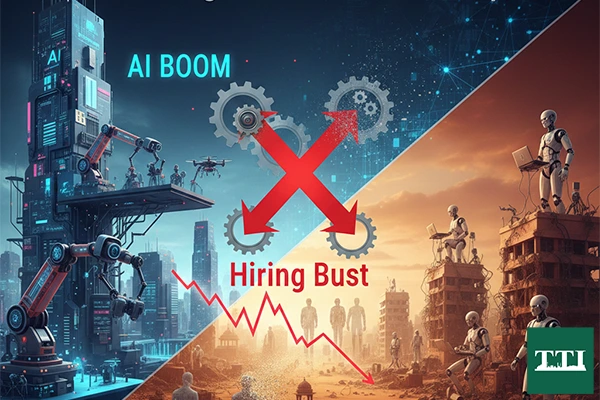
For decades, the Indian IT sector has been the world’s “engine room,” fueled by a seemingly inexhaustible supply of engineering talent and a “manpower-heavy” business model. However, recent data signals a seismic shift. In a year defined by the meteoric rise of generative AI, the industry’s traditional hiring machine has ground to a near-halt.
According to a recent analysis by Computerworld, the top five Indian IT firms added a staggering net total of just 17 employees in the first nine months of the 2025-26 fiscal year. This is a dramatic collapse from the nearly 18,000 net additions recorded during the same period just a year prior.
This “hiring bust” isn’t just a temporary market correction; it is a signal that the AI era has officially arrived, bringing with it a fundamental restructuring of how technology services are delivered.
The AI Paradox: More Output, Fewer People
The most striking aspect of the current landscape is the “AI Paradox.” While client demand for AI-driven solutions is surging and IT firms are reporting healthy revenue growth, their headcount is staying flat—or even shrinking.
Why the Numbers are Stalling
In the past, revenue growth in the Indian IT sector was directly correlated with headcount. If a company won a $100 million contract, they hired a few thousand more developers. Today, that link is being severed by AI-era productivity.
- Automating the Routine: Tasks that once required “armies” of junior developers—such as manual software testing, basic coding, and L1/L2 support—are now being handled by AI agents.
- Smaller, Specialized Teams: Industry analysts note that firms are pivoting from an 80-20 model (80% human labor, 20% technology) to a model aiming for 50-50 or even 20-80.
- The End of the “Bench”: Traditionally, IT firms kept a “bench” of unassigned employees ready for new projects. AI allows for such high productivity that firms can operate with much tighter utilization and smaller benches.
The Talent Shortage: Why Firms Can’t Hire (Even if They Want To)
While automation is reducing the need for generalist roles, there is an acute shortage of specialized talent. The “hiring bust” is partially a “skills bust.”
The 1:10 Gap
Forrester reports a sobering statistic: India currently has only one qualified engineer for every ten generative AI jobs. Despite having millions of IT professionals, only an estimated 15% to 20% of the current workforce possesses “AI-ready” skills.
High Salary Inflation
The scarcity of GenAI specialists has led to massive salary inflation for niche roles. IT giants are finding it difficult to hire at scale because the few qualified candidates are being lured by Global Capability Centres (GCCs) or startups offering significantly higher compensation.
Read our previous post: The End of India’s IT Jobs Boom: How AI and Automation are Rewriting the Tech Playbook
Shifting Strategies: From Campus Recruitment to Reskilling
With the traditional mass-hiring model failing, India’s “Big Five”—TCS, Infosys, Wipro, HCLTech, and Tech Mahindra—are radically changing their HR playbooks.
Internal Transformation
Rather than looking outward for new talent, companies are looking inward.
- TCS has reportedly trained over 217,000 employees in advanced AI skills—a threefold increase in just one year.
- Infosys is deploying over 100 generative AI agents internally to automate its own workflows, essentially “dogfooding” the technology they sell to clients.
The Rise of Subcontracting and Gig Work
To manage variable demand without increasing permanent headcount, firms are increasingly turning to subcontracting. This allows them to stay “lean” while still delivering on high-value AI projects.
The Future for Fresh Graduates: A “Skills-First” Reality
For decades, a degree from a top engineering college was a guaranteed ticket into an IT major. In 2026, the gate is narrowing.
Selectivity is the New Normal
While firms like TCS still recruit from campuses, they are no longer hiring “generalists.” They are looking for “AI-fluency” from day one. Freshers are now expected to be familiar with:
- Vibe Coding and AI-Assisted Development: The ability to use AI to write, debug, and optimize code.
- Cross-Functional Skills: Being “interoperable” across teams, blending coding with data science or cybersecurity.
- Outcome-Based Performance: Junior roles are increasingly measured by the value they add to an AI-augmented process, rather than hours billed.
Conclusion: A Structural Rebirth
The fact that India’s top IT firms added only 17 net employees in nine months isn’t a sign of industry decline—it’s a sign of evolution. We are witnessing the death of the “body shop” model and the birth of a leaner, more innovative tech sector.
For the Indian workforce, the message is clear: the boom isn’t over, but the rules have changed. The future belongs not to those who can code, but to those who can master the AI that codes.
Also read: IIM Bodh Gaya Boosts AI Education: Strategic Partnership with Automation Anywhere