


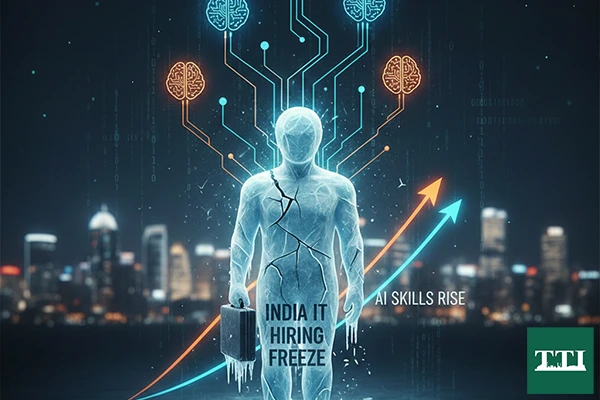
The era of “mass recruitment” in India’s IT sector has officially hit a standstill. For decades, India’s technology giants—TCS, Infosys, Wipro, and others—were the primary engines of white-collar employment, absorbing hundreds of thousands of fresh graduates every year. However, recent data signals a seismic shift: the traditional hiring boom is over, replaced by a “skills-first” era where Artificial Intelligence (AI) and specialized expertise are the new gatekeepers.
The Collapse of Traditional IT Recruitment
The scale of the hiring slowdown is unprecedented. In the first nine months of the current financial year, India’s top five IT firms collectively added a mere 17 net employees. To put this in perspective, during the same period just one year prior, these same companies added nearly 18,000 workers.
Industry experts suggest this isn’t just a temporary dip but a structural transformation. Companies are moving toward a “stable headcount” model, similar to mature industries like manufacturing. Future hiring will largely focus on replacing attrition and retirement rather than aggressive workforce expansion.
Key Factors Driving the Hiring Freeze:
- Automation of Entry-Level Tasks: Tasks that once required armies of junior developers—such as basic coding, software testing, and documentation—are now being handled by AI agents.
- Client Budget Realignment: Global clients are tightening their belts, demanding higher efficiency and better returns on existing digital systems rather than launching massive new transformation projects.
- Operational Maturity: IT firms are prioritizing “leaner” teams that leverage automation to maintain productivity without increasing headcount.
The Rise of Global Capability Centres (GCCs)
While traditional IT service firms are slowing down, a new growth engine has emerged: Global Capability Centres (GCCs). These are offshore units of multinational corporations (like Google, Goldman Sachs, or Walmart) that handle complex R&D, analytics, and digital services for their parent companies.
India currently hosts over half of the world’s GCCs. Unlike IT services firms that thrived on volume, GCCs focus on value. They are projected to add between 2.8 million and 4 million jobs by 2030, but there is a catch—they aren’t looking for generalists.
Why GCCs are the New Power Players:
- Specialized Focus: They hire for niche roles in AI engineering, cloud architecture, and cybersecurity.
- Higher Entry Barriers: GCCs typically seek experienced professionals or “elite” freshers with high-level digital literacy.
- Direct Impact: Employees work directly on core products and global strategies of parent firms, requiring deeper domain knowledge.
Read our previous post: IIM Bodh Gaya Boosts AI Education: Strategic Partnership with Automation Anywhere
AI Skills: The New Currency of the Job Market
The phrase “AI is taking jobs” is only half true. While AI is eliminating repetitive, rule-based roles, it is simultaneously creating a talent war for those who can build and manage these systems. In 2026, AI literacy is no longer a “plus”—it is a baseline requirement.
Most In-Demand Skills in 2026:
- Generative AI & Agentic AI: Building autonomous systems that can plan and execute complex tasks.
- Cloud-Native Engineering: Designing applications specifically for cloud environments (AWS, Azure, GCP).
- Cybersecurity & Threat Intelligence: Protecting data in an increasingly automated world.
- Data Science & Data Engineering: Managing the massive datasets required to train AI models.
“The distinction will be much more focused as people mature and get deeper in their career,” says Salil Parekh, CEO of Infosys. The company is now focusing on a narrow set of advanced AI skills to build platforms that require limited human intervention.
The Impact on Freshers and Mid-Level Professionals
The “hiring freeze” doesn’t mean no one is getting hired; it means the hiring criteria have fundamentally changed.
For Fresh Graduates:
The “campus-to-cubicle” pipeline has become much narrower. Companies are moving away from hiring thousands of students based on general aptitude. Instead, they are looking for “AI-native” graduates. Some firms, like HCLTech and Infosys, are reportedly offering premium packages of ₹20–22 lakh per annum for freshers with elite specialized skills—a stark contrast to the stagnant entry-level salaries of the past decade.
For Mid-Level Professionals:
This group faces the most pressure. Mid-level coordination roles are increasingly vulnerable to AI disruption. To survive, these professionals must transition from “project managers” to “AI orchestrators.” Internal reskilling programs have become a lifeline; companies like TCS have already trained over 217,000 employees in high-order AI competencies.
Conclusion: A Shift from Headcount to Skill Velocity
India’s IT landscape is entering a high-velocity growth phase, but it is one measured by innovation rather than employee count. The year 2026 marks an inflection point where the industry moves from “recovery” to “reinvention.”
For job seekers, the message is clear: the days of relying on a degree and basic coding skills are gone. Success in the new era of Indian IT depends on continuous upskilling, AI fluency, and the ability to work alongside machines.
Also read: Soorarai Pottru (2020) – Based on Real Life: True Story Behind the Film