


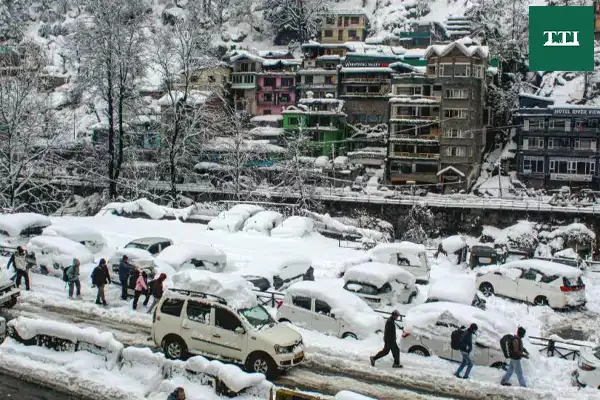
Heavy snowfall across the western Himalayan region has brought life to a standstill in Himachal Pradesh, Uttarakhand, and Kashmir. Over the last 48 hours, the region has transitioned from a prolonged dry spell to a winter crisis. In Himachal Pradesh, the popular tourist hubs of Shimla and Manali are currently bearing the brunt of this seasonal shift, struggling to balance a massive influx of visitors with the collapse of essential infrastructure.
A Long Weekend of Gridlock and Stranded Travelers
The arrival of fresh snow coincided with the long Republic Day weekend, drawing thousands of tourists to the hills. However, the dream of a winter wonderland quickly turned into a nightmare for many. Slippery road conditions combined with a heavy surge in vehicle inflow resulted in a massive 15-kilometer traffic jam near Manali. The Chandigarh-Manali Highway became a virtual parking lot, with vehicles crawling for hours or stopping entirely.
Reports indicate that over 600 tourists were stranded near Manali alone. The severity of the congestion forced many travelers to spend the night inside their cars. Personal accounts from the scene paint a grim picture; some tourists chose to abandon their vehicles and walk up to seven kilometers to reach Manali on foot. Others, like a group from Delhi, reported surviving the night in their vehicles by cooking basic meals on portable cylinders while waiting for the traffic to move.
Also Read: 15 Minutes to Comply or Death: The Chilling Ultimatum Behind Maduro’s Capture
Infrastructure Collapse and Utility Disruptions
The heavy snowfall has severely impacted the state’s utility networks. According to the State Disaster Management Authority (SDMA), nearly 683 roads across Himachal Pradesh have been blocked, including critical arteries like National Highway 03 (Koksar–Darcha) and NH-505 (Gramphu–Batal). Public Works Department Minister Vikramaditya Singh confirmed that while heavy machinery like JCBs and poclain machines are working around the clock, the sheer volume of snow—reaching up to four feet in high-altitude areas—has made clearance a slow and arduous process.
Beyond transport, the state is grappling with a significant utility crisis. Over 5,700 distribution transformers have been disrupted, leaving large portions of Shimla and surrounding rural areas without electricity for over 30 hours. Water supply has similarly been hit, with 126 schemes currently affected. Local authorities have warned that in remote rural pockets, it could take nearly a week to fully restore power and water services.
Profiteering Allegations and Economic Paradox
As public transport remained suspended due to the weather, many tourists found themselves at the mercy of private operators. There have been widespread allegations of taxi owners overcharging stranded travelers, with some reportedly demanding between ₹10,000 and ₹15,000 for short 20-kilometer journeys between Manali and Patlikuhal.
Paradoxically, despite these hardships, the tourism industry is seeing a significant boost in numbers. Hotel occupancy in Shimla is expected to hit 80%, while Manali anticipates reaching 70% occupancy once the roads are cleared. However, this surge brings its own set of challenges for business owners. The Shimla Hotels and Tourism Stakeholders’ Association noted that while the footfall is welcome, hoteliers are having to spend significantly from their own pockets to maintain generators and ensure that guests have access to uninterrupted power and water.
Strategic Closures and Ongoing Rescue Efforts
The impact of the storm extends to strategic routes and neighboring states. The Manali–Lahaul route via the Atal Tunnel remains closed, and key passes such as Rohtang and Sarchu are inaccessible. In Lahaul-Spiti alone, 290 roads are currently shut down.
Rescue operations are in full swing across the northern belt. In Kullu, local police and residents successfully rescued 12 tourists stranded near Raghupur Fort. Similar stories emerged from Uttarakhand, where nearly 200 people were pulled from snowbound stretches of the Yamunotri highway. In Kashmir, the situation was equally intense, with over 1,600 tourists requiring rescue from Gulmarg and Tangmarg after the area received over 50 cm of fresh snow.
Looking Ahead: More Weather on the Horizon
The respite may be brief, as the Himachal Pradesh government has issued a fresh advisory regarding another predicted spell of rain and snow between January 26 and 28. District administrations have been ordered to keep emergency operation centers active 24/7 and to ensure that snow clearance teams are ready for immediate deployment. For now, authorities are urging both residents and tourists to avoid unnecessary travel and exercise extreme caution as the region prepares for the next wave of winter weather.
Also Read: ICC Faces Criticism Over ‘Inconsistency’ Following Bangladesh’s Ejection from T20 World Cup