


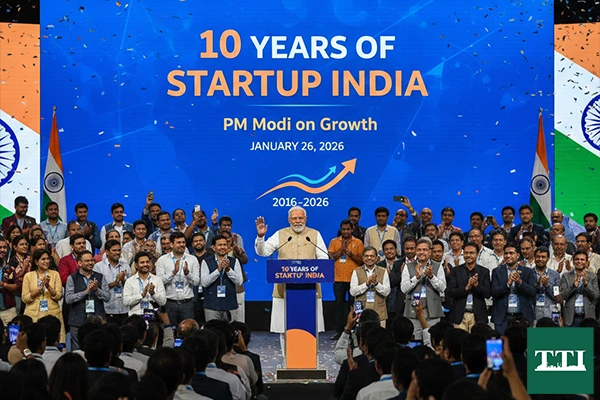
The Indian startup ecosystem has reached a historic milestone. As the nation celebrates a decade of the Startup India initiative, the landscape of Indian entrepreneurship has shifted from humble beginnings to a global powerhouse. From Prime Minister Narendra Modi’s reflections on 10 years of innovation to massive state-led AI missions and record-breaking funding rounds, the current state of Indian startups signals a transition into a “quality-first” growth phase.
In this article, we delve into the top startup news today, exploring how India is positioning itself as the third-largest startup hub in the world.
1. PM Modi on 10 Years of Startup India: From 500 to 2 Lakh Ventures
In the 130th episode of Mann Ki Baat, Prime Minister Narendra Modi took a moment to celebrate the incredible journey of the Startup India initiative, which was launched in January 2016. The transformation is nothing short of a revolution:
- Growth at Scale: India started with fewer than 500 recognized startups in 2016; today, that number has surged past 2 lakh recognized ventures.
- The World’s Third Largest Hub: India is now firmly established as the third-largest startup ecosystem globally.
- Deep-Tech Focus: The Prime Minister highlighted that Indian startups are no longer limited to consumer apps. They are now pioneers in SpaceTech, Green Hydrogen, Biotechnology, and Semiconductors.
- The Vision for 2047: Looking toward a Viksit Bharat (Developed India), PM Modi urged entrepreneurs to shift their focus from quantity to “quality, quality, and only quality” to compete on the global stage.
2. State-Led Innovation: Uttar Pradesh, Haryana, and Madhya Pradesh Take the Lead
While the central government provides the framework, Indian states are now competing to become regional innovation hubs.
Uttar Pradesh’s Centres of Excellence (COEs)
The Government of Uttar Pradesh has approved 7 Centres of Excellence focused on frontier technologies. With an investment of ₹27.18 crore already released, these centers in cities like Lucknow, Kanpur, and Noida will focus on:
- Artificial Intelligence and Blockchain
- Drone Technology and 5G/6G Telecom
- MedTech and Additive Manufacturing
Haryana’s ₹474 Crore AI Mission
Haryana is making a massive bet on Artificial Intelligence. The state announced the Haryana AI Mission, backed by World Bank assistance, to establish AI hubs in Gurugram and Panchkula. The mission aims to train 50,000 youth in emerging technologies, ensuring a steady pipeline of talent for the future.
Madhya Pradesh’s Global Collaboration
At the World Economic Forum 2026 in Davos, the Madhya Pradesh government engaged with the Israel Innovation Authority (IIA). This partnership aims to bring Israeli R&D expertise to MP, focusing on water solutions, quantum technology, and defense tech.
3. Funding Frenzy: Weekly Roundup and Big Bets
The first month of 2026 has seen a significant surge in investor confidence. Between January 17th and 23rd, Indian startups raised approximately $400 million, representing a sevenfold increase year-on-year.
Major Deals to Watch:
- Juspay: Successfully raised $50 million, officially becoming India’s first unicorn of 2026.
- GreenCell Mobility: Secured $89 million to further the electric mobility agenda.
- Neysa: Global giant Blackstone finalized a structured investment of $50-$75 million in this Mumbai-based AI cloud infrastructure startup.
- Whizzo: A materials science startup raised $15 million in Series A funding to revolutionize technical textiles.
4. Sector Spotlight: Defense Tech and SpaceTech
2025 and early 2026 have marked a turning point for “hard tech” in India.
Defense Tech’s Breakthrough Year
Defense-technology startups recorded their strongest funding year ever, with global VC investment reaching $49.1 billion. In India, the validation of autonomous systems and battlefield AI has led to a surge in interest from investors who previously shied away from the long gestation periods of defense contracts.
India’s First Private Satellite Constellation
IN-SPACe has partnered with a consortium of startups—including Pixxel, Dhruva Space, PierSight, and SatSure—to build India’s first private Earth observation constellation. Named ‘Allied Orbits,’ the group will invest over ₹1,200 crore to deploy 12 satellites, reducing India’s dependence on foreign satellite data.
5. Ecosystem Resilience: Salvaging Value from Failure
In a mature ecosystem, failure is seen as a stepping stone rather than a dead end. The Digital India Foundation launched the Phoenix Hub, a unique platform designed to repurpose technology and talent from startups that have shut down.
By salvaging working code, patents, and skilled talent from failed ventures in SaaS and Fintech, the Phoenix Hub aims to reduce “ecosystem waste” and ensure that innovation is never truly lost.
6. Inclusive Growth: Beyond the Metros
The narrative of Indian startups is moving beyond the “Silicon Valley of India” (Bengaluru).
- Startup Republic: A campaign by PayU is featuring 36 founders from every state and Union Territory, showcasing grassroots innovation.
- Tamil Nadu & SanchiConnect: A new partnership is focusing on deep-tech startups in Tier-2 and Tier-3 cities, providing mentorship and market access to founders outside major metro hubs.
Conclusion: The Road Ahead for Startup India
The next decade of the Indian startup story will be defined by deep-tech, sustainability, and global quality standards. With strong institutional support from HDFC Bank’s ₹20 crore grant program and strategic MoUs like the one between IIT Roorkee and AccelESG, the infrastructure for the next generation of entrepreneurs is firmly in place.
As India enters this new growth phase, the focus remains clear: building scalable, high-quality solutions that solve not just Indian problems, but global challenges.