


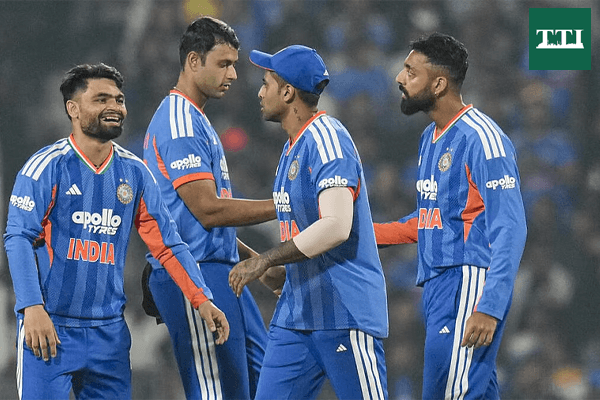
As the world prepares for the ICC Men’s T20 World Cup 2026, the defending champions have sent a resounding message to their competitors. Following a dominant 4-1 series victory over New Zealand, the Indian cricket team appears physically and mentally primed to retain their title on home soil. Co-hosting the tournament with Sri Lanka, India has utilized their final bilateral matches to fine-tune a squad that seamlessly blends explosive batting with clinical bowling.
The series against the Black Caps was more than just a win; it was a showcase of India’s ruthless approach to the shortest format. While New Zealand managed to snatch a victory in the fourth game, the final match in Thiruvananthapuram underscored India’s superiority. Posting a massive 271/5, India dismantled the visitors’ bowling attack before Arshdeep Singh’s five-wicket haul sealed a 46-run win. This momentum is vital as the team transitions into the global stage.
Power at the Top and Middle Order Depth
India’s batting strategy has evolved into a high-risk, high-reward model that prioritizes momentum over safety. Throughout the New Zealand series, the opening pair of Abhishek Sharma and Ishan Kishan proved to be a “X factor.” While Abhishek Sharma continued his rise with a staggering strike rate, it was Ishan Kishan who truly lit up the final stages. His explosive 103 off 43 balls in the fifth T20I acted as a definitive statement, securing his spot in the lineup as a primary game-changer.
Skipper Suryakumar Yadav also addressed concerns regarding his own form. After a lean period in late 2024, he finished the series at the top of the run charts with 242 runs. His ability to anchor the innings while maintaining a high scoring rate provides the middle order with the stability it needs. Further down the order, the “riches” of Hardik Pandya, Rinku Singh, and Shivam Dube offer unparalleled depth. Dube’s remarkable series strike rate of nearly 250 and Rinku’s ability to find boundaries from the first ball ensure that the run rate never stalls, even if early wickets fall.
Also Read: Proteas Primed: Markram’s South Africa Gains World Cup Momentum After Hard-Fought West Indies Series
A Balanced and Versatile Bowling Attack
While the batting often grabs the headlines, India’s bowling attack has become a multi-dimensional force. The leadership of Jasprit Bumrah remains central; his ability to control both the Powerplay and the death overs allows the captain to use other bowlers aggressively. Arshdeep Singh’s recent five-wicket haul has solidified his place in the starting XI, proving his knack for picking up wickets under pressure despite occasionally being targeted by aggressive hitters like Finn Allen.
Spin remains a cornerstone of India’s strategy, especially on home tracks. The return of Axar Patel from injury provided a significant boost; his performance in the final game showed he could maintain control on flat wickets with small boundaries. Alongside the mystery spin of Varun Chakaravarthy and the agility of Ravi Bishnoi, India possesses enough variety to exploit any conditions. The tactical decision to include an extra batter at number eight—relying on a core of specialist bowlers supplemented by the all-round capabilities of Pandya and Dube—highlights a commitment to a balanced, aggressive philosophy.
Sustaining Consistency and Addressing Challenges
The numbers backing India’s claim to the throne are staggering. Since their 2024 World Cup triumph, the team has won 30 out of 40 matches, maintaining a win rate of 75 percent. This level of consistency is rare in T20 cricket, where a single bad over can swing a match. By winning eleven consecutive bilateral series, India has developed a habit of winning that persists regardless of the venue or the opposition.
However, the path to a title defense is never without hurdles. While the team is firing on almost all cylinders, the form of certain individuals, like Sanju Samson, has been a point of discussion. Despite the home advantage, the pressure of expectation as defending champions is immense. Former captain Sourav Ganguly has noted that while India is currently at its best, the challenge lies in peaking at the right moment during the tournament itself rather than just before it.
Defending the Crown on Home Soil
No team has ever won the Men’s T20 World Cup at home while simultaneously defending their title. India is now positioned to break that historical trend. The squad has closed off the traditional “escape routes” for opponents by ensuring their scoring remains relentless and their bowling remains adaptable.
With the first group match against the USA scheduled for February 7, followed by a high-stakes encounter with Pakistan on February 15, the schedule demands immediate focus. Head Coach Gautam Gambhir has returned to Delhi with a squad that is no longer just hopeful but prepared. If India can maintain the intensity shown against New Zealand and match their tactical brilliance with sharp fielding, they will not only be champions again but will set the definitive standard for the T20 format.
Also Read: Calculated Aggression: Pakistan Finds Form and Focus to Challenge for T20 World Cup Glory