


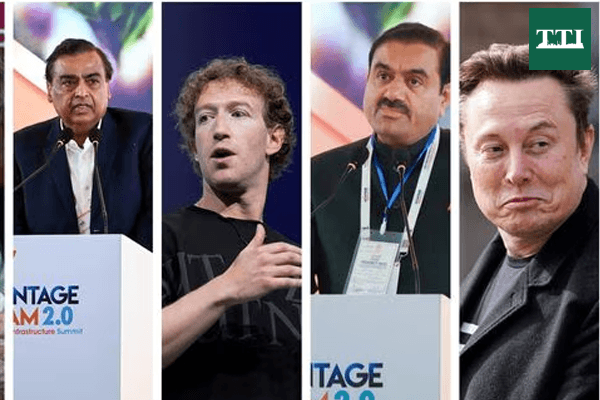
The concept of the world’s wealthiest individuals solving global crises is often dismissed as a dinner-table fantasy. However, recent data-driven analysis suggests that if the top ten richest people on the planet—including Elon Musk, Jeff Bezos, Mark Zuckerberg, and Warren Buffett—parted with exactly half of their fortunes, the resulting capital could fundamentally reshape human history. This hypothetical scenario involves a staggering USD 1.25 trillion, a sum so vast it challenges our understanding of global economic capacity.
To put this figure into perspective, USD 1.25 trillion converts to approximately Rs 113.24 lakh crore (at an exchange rate of Rs 90.59 per dollar). This amount is more than double the entire planned expenditure of the Government of India for the 2026–27 financial year. It represents a pool of liquid potential that could, in theory, address some of the most persistent challenges facing humanity today.
What a Trillion Dollars Can Actually Fix
The most immediate impact of such a donation would be seen in the fight against extreme poverty. According to 2025 research from institutions including UC Berkeley and Stanford, the annual cost to reduce global extreme poverty to just one percent of the population is USD 318 billion. With USD 1.25 trillion, the world could fully fund these interventions for nearly four years. These programs are not experimental; they rely on proven methods such as direct cash transfers, which have been shown in studies across Kenya and Uganda to stabilize households, improve food security, and keep children in school within months.
Beyond poverty, the funds could tackle the growing “loss and damage” caused by climate change. The UNFCCC estimates that developing nations will need between USD 300 billion and USD 580 billion annually by 2030 to recover from climate-related disasters. A single injection of billionaire wealth could provide a massive head start in building resilience and protecting vulnerable livelihoods. Furthermore, the World Health Organization (WHO) suggests that preparing for future pandemics would cost roughly USD 31 billion annually, while scaling up primary healthcare globally would require between USD 100 billion and USD 275 billion. The donated wealth could cover these health costs several times over, potentially saving tens of millions of lives by 2030.
Also Read: Tragedy in Janakpuri: Delhi Man Falls to Death in Open Jal Board Pit
Why This Money Never Moves
Despite the clear mathematical benefits, several systemic barriers prevent this wealth from being deployed. The first is liquidity. Most of the wealth held by individuals like Larry Page or Bernard Arnault is tied up in company shares. If these titans attempted to sell tens of billions of dollars in stock simultaneously, it would likely trigger a market collapse, devaluing the very assets intended for donation.
Even if the cash were available, the world lacks the institutional “plumbing” to handle it. Nobel Prize-winning economists Angus Deaton and Esther Duflo have noted that massive financial inflows can overwhelm weak institutions. Deaton warns that such surges can distort political incentives, while Duflo’s research indicates that poor governance can neutralize even the best-funded programs. Recent audits from the United Nations Office of Internal Oversight Services confirm that global agencies already struggle with delays and oversight when managing existing budgets; a trillion-dollar surge might swamp these systems rather than accelerate them.
The Growing Gap and Political Dimensions
The urgency of this discussion is highlighted by the rapid growth of billionaire wealth. Oxfam’s 2026 analysis reveals that billionaire wealth grew by 16% in 2025 alone, reaching a total of $18.3 trillion—an 81% increase since 2020. This growth occurs alongside a sobering reality where one in four people globally struggle to eat regularly.
Furthermore, philanthropy often moves at a glacial pace. In the United States, private foundations typically only disburse the legally required 5% of their endowments annually. This means wealth often stays invested rather than being deployed during crises. There is also a political hurdle: billionaires are now significantly more likely to hold political office or influence policy than the average citizen. A sudden, large-scale redistribution of wealth would shift political pressures and reopen debates on corporate accountability and taxation that many in the ultra-wealthy tier might find unfavorable.
Wishful Thinking, But What If?
If the logistical and political barriers were cleared, the transformation would be profound. Families would gain security, health systems would become robust, and countries would recover from disasters with unprecedented speed. The most striking realization of this scenario is that after donating half their wealth, these ten individuals would still wake up as billionaires. Their personal lifestyles would remain virtually unchanged, yet the lives of billions of others would be irrevocably improved. This reality suggests that the world does not lack the resources or the data to solve its greatest problems; it lacks the mechanism to move wealth at the scale the current era demands.
Also Read: From 50% to 18%: How India’s New Trade Pact with the US Reshapes Global Supply Chains