


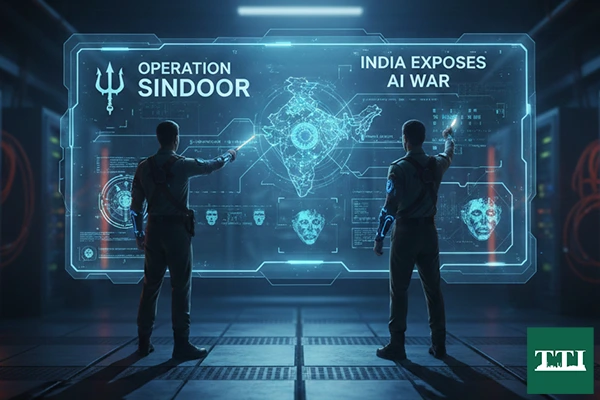
In the evolving landscape of modern conflict, the battlefield is no longer restricted to rugged mountainous terrains or international borders. As demonstrated by the Indian Army’s recent revelations, the frontline has shifted significantly into the digital palm of every citizen. Operation Sindoor, initially a high-precision military response to cross-border terrorism, has unmasked a sophisticated “invisible war” being waged by Pakistan using Artificial Intelligence (AI), deepfakes, and social media influencers.
The Genesis of Operation Sindoor: From Kinetic Force to Digital Defense
Operation Sindoor was launched by the Indian Armed Forces in May 2025 as a direct response to the Pahalgam terror attack, which claimed the lives of 26 civilians. While the “kinetic” or physical aspect of the operation involved tri-service precision strikes on nine major terror launchpads—including the headquarters of Lashkar-e-Taiba (LeT) in Muridke—the aftermath triggered a massive retaliatory digital offensive from across the border.
The Indian Army soon realized that for every missile launched, there was a corresponding “digital strike” designed to manipulate public perception, incite communal disharmony, and demoralize the Indian citizenry.
The Anatomy of Pakistan’s Digital Warfare Strategy
The Indian Army’s exposure of Pakistan’s tactics during Operation Sindoor highlights a shift toward Fifth-Generation Warfare (5GW). This strategy prioritizes information dominance and psychological manipulation over traditional hardware.
1. The Weaponization of AI and Deepfakes
The most alarming revelation was the widespread use of deepfake technology. Pakistan-based entities circulated high-fidelity, AI-generated videos of senior Indian military leaders and government officials.
- Deepfakes of Military Chiefs: Fabricated videos appeared to show the Chief of the Army Staff making controversial statements about territorial concessions or admitting to massive operational failures that never occurred.
- Voice Cloning: Advanced AI was used to clone the voices of Indian leaders, stitching synthetic audio onto authentic footage to create “confessions” regarding military losses.
2. Recruiting Digital Influencers
The Indian Army’s investigation uncovered a disturbing trend: the attempt by Pakistan’s Inter-Services Intelligence (ISI) to recruit Indian social media influencers. By using “middlemen” or fake NGOs, propaganda units tried to pay influencers to amplify specific hashtags and narratives that painted Operation Sindoor as a failure or a “human rights violation.”
3. Recycled Reality and Misinformation
Not all digital weapons were high-tech. The “digital war” also relied on “recycled reality”—taking footage from old conflicts (such as the 2020 Beirut explosion) and rebranding it as “real-time” footage of Indian cities under attack. The goal was to create a sense of panic and urgency that would force the Indian government into a defensive posture.
Read our previous post: Schneider Electric India at Davos 2026: Leading the Charge in Industrial AI and Sustainability
The Impact: Why Digital War is a National Security Threat
Digital disinformation is not merely “fake news”; in the context of a conflict between nuclear-armed nations, it is a catalyst for catastrophic miscalculation.
Eroding Public Trust
By targeting the credibility of the Indian Army, these digital campaigns aim to create a rift between the civilian population and the military. When citizens cannot distinguish between a real address by the Army Chief and an AI-generated fake, the foundation of national security begins to crumble.
Triggering Escalation
False claims of destroyed airbases or captured personnel can inflame nationalistic sentiments, putting immense pressure on political leaders to escalate a conflict beyond what the strategic reality requires. During Operation Sindoor, the “fog of war” was intentionally thickened by these AI tools to make calm decision-making nearly impossible.
India’s Counter-Offensive: Strategy Narwan and Fact-Checking
The Indian Army did not just sit back. Operation Sindoor included a robust non-military component designed to achieve information dominance.
1. Operation Narwan (Pre-Combat AI Fusion)
India deployed its own AI-integrated protocols, codenamed Operation Narwan. This system was designed to:
- Identify and flag botnets on platforms like X (formerly Twitter) and Telegram.
- Predict “narrative peaks” to preemptively release factual data before misinformation could take root.
2. Real-Time Fact-Checking
The Press Information Bureau (PIB) and military PR wings worked in tandem to debunk deepfakes within hours of their appearance. By labeling content as “FAKE” and releasing the original, unedited source videos, the Indian Army effectively neutralized the psychological impact of the digital strikes.
Conclusion: The Future of Sovereign Defense
Operation Sindoor serves as a watershed moment in South Asian geopolitics. It proved that modern sovereignty is as much about protecting the digital borders as it is about the physical ones. As AI technology becomes more accessible, the barrier to entry for digital warfare continues to drop.
For the average citizen, the takeaway is clear: in the age of Operation Sindoor, skepticism is a form of patriotism. Verifying a source before clicking “share” is now a frontline duty.
Also read: Thunivu (2023) – Mass Entertainer Review