


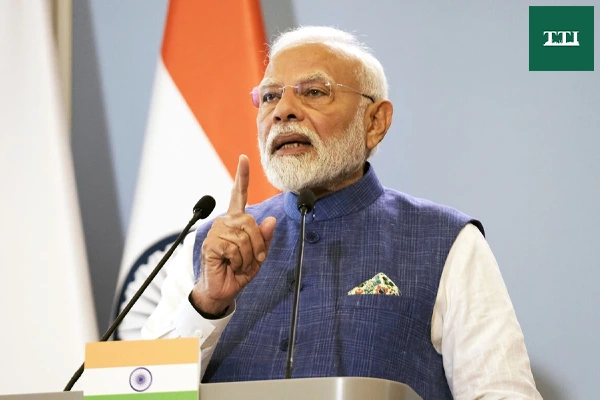
In the latest edition of the India Today-CVoter Mood of the Nation (MOTN) survey for January 2026, the Indian political landscape reveals a compelling paradox: while Congress leader Rahul Gandhi is experiencing a significant surge in personal popularity, Prime Minister Narendra Modi remains the undisputed titan of national politics, with the ruling Bharatiya Janata Party (BJP) projected to return to a comfortable solo majority.
The Leadership Gap: Brand Modi vs. The Rising Challenger
The survey highlights a widening gap between the two primary contenders for the Prime Minister’s office. Prime Minister Narendra Modi continues to be the most preferred choice for the country’s top post, with 55 percent of respondents backing him. This represents a steady climb from 52 percent in August 2025 and 49 percent in August 2024. This resilience is attributed to what analysts call the “trust factor,” bolstered by a perceived strong foreign policy—including recent trade deals with the UK and EU—and a firm stance on national security following the Pahalgam terror attack.
On the other side, Rahul Gandhi has registered remarkable steady gains. The January 2026 data shows that 27 percent of the nation now sees him as the best-suited Prime Minister. While still trailing the Prime Minister by 28 percentage points, Gandhi’s trajectory is notable; his support has nearly quadrupled since January 2022, when it stood at a mere 7 percent. His rising profile suggests he is increasingly viewed as a viable national alternative, though he has yet to cross the threshold required to challenge Modi’s dominance directly.
Also Read: The Achilles’ Heel? MOTN Poll Suggests Congress is the Weakest Link in the INDIA Bloc
Electoral Projections: BJP Recovers, Congress Slips
Despite Rahul Gandhi’s personal popularity boost, the survey indicates that this has not yet translated into electoral momentum for the Congress party. If Lok Sabha elections were held today, the BJP is projected to secure 287 seats on its own—well above the “magic number” of 272 required for a majority. This marks a sharp recovery from the 240 seats it won in the 2024 General Election and a gain of 27 seats compared to the August 2025 survey.
In contrast, the Congress is projected to win only 80 seats, a significant decline from the 99 seats it secured in 2024 and a drop of 17 seats since the last MOTN survey. At the alliance level, the BJP-led National Democratic Alliance (NDA) is expected to command a powerful 352 seats, while the opposition INDIA bloc is projected to slip to 182 seats. The survey suggests that the opposition’s “vote chori” narrative has failed to resonate widely with the public, leaving the Congress as what 62 percent of respondents label the “weakest link” within the opposition alliance.
Public Approval and Government Performance
Public approval of Prime Minister Modi’s performance remains high and stable. In January 2026, 57 percent of respondents rated his work as “good,” only a marginal dip from 58 percent in August 2025. Approximately 16 percent rated it as “average,” while 24 percent described it as “poor.”
The survey indicates that “political stability” has emerged as the government’s primary success in the eyes of the voters, surpassing even cultural and legal milestones like the Ram Temple or the abrogation of Article 370. This sense of stability seems to outweigh concerns over the economy, even as the opposition continues to highlight issues of “crony capitalism” and rising inequality.
Regional Dynamics and Vote Share
The NDA’s dominance is further reflected in its projected vote share, which is expected to rise to 47 percent, up from the 44 percent it received in the 2024 polls. The INDIA bloc, meanwhile, is expected to see its vote share settle at 39 percent.
Regional data provides a more nuanced view. In West Bengal, the Trinamool Congress (TMC) remains a formidable force, projected to win 28 seats, though the BJP is slowly gaining ground with a projected 14 seats. In Assam, the NDA is in a commanding position, projected to win 12 out of 14 seats. These figures suggest that while regional parties hold their ground in certain pockets, the national trend leans heavily toward the incumbent government.
Ultimately, the January 2026 MOTN survey paints a picture of a nation that is increasingly appreciative of Rahul Gandhi’s growth as a leader but remains firmly anchored in the stability provided by “Brand Modi.” As the 2026 assembly elections approach in states like West Bengal and Tamil Nadu, these findings provide a critical snapshot of a country where the incumbent remains far ahead, even as the challenge from the opposition grows more focused.
Also Read: Proteas Power-Up: David Miller Cleared for T20 World Cup Following Injury Scare