


The latest India Today-CVoter Mood of the Nation (MOTN) survey, conducted in January 2026, paints a picture of significant political consolidation for the ruling National Democratic Alliance (NDA) while posing serious questions for the opposition INDIA bloc. If Lok Sabha elections were held today, the results suggest a decisive shift in momentum back toward the Bharatiya Janata Party (BJP) and its allies, reversing some of the gains seen by the opposition in the 2024 general elections.
NDA Surges Toward Greater Dominance
The survey projections indicate that the NDA is comfortably positioned to return to power with an even stronger mandate than it currently holds. According to the poll, the NDA would secure 352 seats if elections were held today, a substantial increase from the 293 seats it won in the 2024 Lok Sabha elections. This growth is mirrored in the vote share, where the ruling alliance is projected to garner 47% of the total vote, up from the 44% it received in the actual 2024 polls.
The primary engine of this growth is the BJP itself. The party, which fell short of a simple majority in 2024 with 240 seats, is now projected to win 287 seats on its own. This would allow the BJP to cross the 272-seat magic number independently, reducing its reliance on key allies for survival. The survey suggests that the BJP has successfully recovered political ground lost during the mid-2024 period, with its individual vote share holding steady at 41%.
Also Read: MOTN Poll 2026: NDA Maintains Lead Amid Rising “Vote Chori” Concerns and Economic Debate
The INDIA Bloc and the Congress Challenge
In contrast, the opposition INDIA bloc appears to be losing the momentum it built during the last general election. The alliance, which surprised many by winning 234 seats in 2024, is projected to slide to 182 seats if the nation went to the polls today. This represents a loss of 52 seats from its current strength. The bloc’s projected vote share has also dipped to 39%, down from the 40.9% predicted in the August 2025 survey and the 40% it secured in 2024.
A closer look at the data identifies the Congress party as a primary factor in this decline. Often referred to in recent political analysis as the potential “weakest link” of the alliance, the Congress is projected to secure only 80 seats, a sharp drop from the 99 seats it won in the 2024 elections. Despite its attempts to position itself as the principal challenger, the party’s projected vote share has slipped to 20%.
Regional Strongholds and Bipolar Contests
While the national picture favors the NDA, regional dynamics remain complex. In Tamil Nadu, the INDIA bloc continues to maintain a commanding presence, projected to win 38 out of 39 seats. However, even here, the NDA has seen a slight shift in its favor in terms of vote share, despite the lack of seat gains. In West Bengal, the contest is becoming increasingly bipolar. The Trinamool Congress (TMC) is expected to remain the dominant force with 28 seats, but the BJP is projected to marginally increase its tally to 14 seats, signaling its continued relevance as the primary opposition in the state.
In Assam, the NDA’s grip appears to be tightening further. The survey projects the ruling alliance to win 12 out of 14 seats, backed by a significant 54% vote share. This marks a notable increase from the 47% vote share it recorded in 2024, further marginalizing the INDIA bloc in the northeast.
Leadership and Public Approval
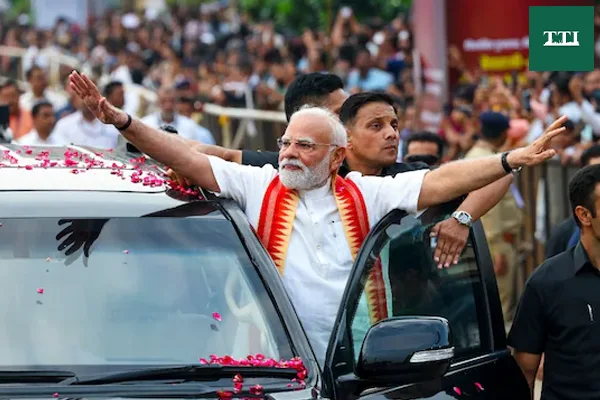
The “Brand Modi” factor remains the cornerstone of the NDA’s electoral strength. Prime Minister Narendra Modi continues to be the most preferred choice for the country’s top post, with 55% of respondents backing him. This is a rise from 52% in August 2025. His performance rating remains stable, with 57% of voters rating it as “good.”
Rahul Gandhi has also seen a steady rise in his personal popularity, with 27% of respondents now viewing him as the best-suited candidate for Prime Minister—a massive leap from the 7% he recorded in 2022. However, the survey highlights a significant gap: while Gandhi’s personal profile is rising, it has not yet translated into equivalent electoral gains for his party.
The public remains divided on several key issues. While 57% of voters believe the electoral process is free and fair, 37% express concerns. Economic issues like price rise and unemployment continue to be the top perceived failures of the government. Nevertheless, the combination of stable leadership and a perceived lack of a cohesive opposition alternative seems to have kept the NDA firmly in the lead in the eyes of the Indian electorate.
Also Read: Kerala’s Political Pulse: UDF Holds the Line as BJP Makes Bold Inroads