


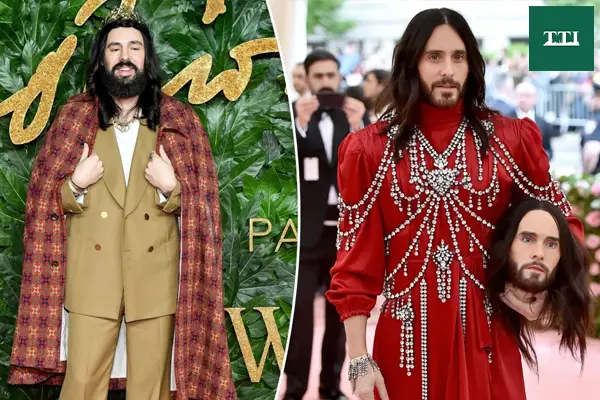
The transition of creative leadership at a storied fashion house is often marked by a respectful nod to the past, but for Alessandro Michele, stepping into the world of Valentino was more than a professional milestone—it was a spiritual homecoming. As the new Creative Director of Valentino, Michele has frequently spoken about the profound impact that the brand’s founder, Valentino Garavani, had on his imagination long before he ever walked through the doors of the Palazzo Mignanelli.
A Presence Like the Pope
Growing up in Rome, Michele viewed Valentino Garavani not just as a fashion designer, but as a permanent fixture of Italian culture and power. In his reflections, Michele likens the founder’s presence in the city to that of the Pope. For a young Roman, Valentino was “familiar” yet untouchable, a man who lived his life with a grandeur that seemed to belong to a different era.
To Michele, Valentino was a “mythical figure” who personified the intersection of the Roman Empire’s historical weight and the modern decadence of the mid-20th century. This connection to Rome—a city Michele describes as being about “God, decadence, beauty, richness, and love affairs”—is the thread that binds the two designers across generations.
Also Read: The Naked Dress: Why We Are Still Obsessed With This Bold Fashion Trend
Challenging the Concept of “Classical”
One of Michele’s most striking insights is his deconstruction of Valentino’s legacy as a “classical” designer. While the fashion world often categorizes Valentino’s work—such as his signature ruffles and fuchsia accents—as the pinnacle of traditional elegance, Michele argues that this perspective is a historical oversight.
According to Michele, Valentino Garavani was a revolutionary. Much like Yves Saint Laurent, Valentino only became the standard of elegance because he was first an innovator who changed the cultural landscape. Michele points out that Valentino lived his life openly and without regret as a gay man in the 1970s, a feat of personal and social bravery that was virtually unheard of in the fashion industry at the time. By building a new culture, Valentino eventually became the culture, which is why we now mistakenly view his radical innovations as merely “classical.”
The Engineering of Beauty
Upon entering the Valentino archives, Michele was struck by the technical complexity of the garments. He describes Valentino not just as a dreamer of beautiful dresses, but as an “engineer” of fashion. Examining the intricate pleats and structures of archival gowns, Michele compares the construction to “origami,” noting the unbelievable precision required to create such fluid beauty.
This technical mastery is something Michele has sought to bridge with his own vision. When discussing a particular gown, Michele notes that the design is “him [Valentino], with me.” He admits that while he occasionally tries to replicate a piece exactly because the original is so fascinating, his goal is usually to find a middle ground where both designers exist within the same dress.
A Philosophy of Freedom
For Alessandro Michele, the most significant part of Valentino’s legacy is the sense of freedom he projected. Michele views his own work as a constant fight against boundaries, aiming to be “like water” moving through small spaces to dismantle limitations. In Valentino’s history, he finds a kindred spirit—someone who proved that it was possible to change one’s life and live authentically.
Michele’s tenure at Valentino is not an attempt to erase the past, but a deep-dive into the “preciousness of life” that he feels when touching the founder’s creations. By embracing the “weirdly chic” and the “unfettered richness” of the house’s history, Michele is ensuring that the mythical figure of Valentino remains a living, breathing influence in the modern world. Through this lens, fashion becomes a reflection on human finality, lightened by the eternal beauty of a well-made dress.
Also Read: Tragedy in Narsingdi: Hindu Youth Burnt to Death Amid Rising Tensions in Bangladesh