


India’s rapid urbanization has led to an increasing need for sustainable, efficient, and well-planned urban spaces. To address this, the Government of India launched the Smart Cities Mission (SCM) in 2015, aiming to transform selected cities into modern urban centers that leverage technology, improve infrastructure, and enhance the quality of life for residents. The mission envisions cities that are citizen-friendly, digitally connected, resource-efficient, and environmentally sustainable. Nearly a decade since its inception, the Smart Cities Mission has made notable progress, but it also faces significant challenges. This article explores the objectives, achievements, strategies, and hurdles of the Smart Cities Mission, providing a detailed analysis of India’s journey toward smarter urban development.
The Smart Cities Mission was designed to address the twin pressures of population growth and urban sprawl. India’s urban population is expected to exceed 600 million by 2031, putting immense strain on infrastructure, housing, transportation, water supply, and sanitation. SCM aims to provide integrated solutions by combining technology, planning, and governance reforms to create cities that are livable, inclusive, and globally competitive.
Objectives and Core Components of the Mission
The Smart Cities Mission focuses on a set of clear objectives to modernize urban areas:
- Infrastructure Development: Enhancing roads, public transportation, sewage systems, energy distribution, and water supply networks to support sustainable urban growth.
- Digital Governance: Implementing e-governance platforms, smart grids, sensor networks, and mobile applications to improve efficiency and citizen engagement.
- Sustainable Urbanization: Promoting green buildings, renewable energy, rainwater harvesting, waste recycling, and pollution reduction measures.
- Citizen-Centric Services: Enhancing healthcare, education, security, and emergency response services through technology-enabled solutions.
- Economic Development: Encouraging industrial and commercial growth, job creation, and entrepreneurship through planned urban hubs.
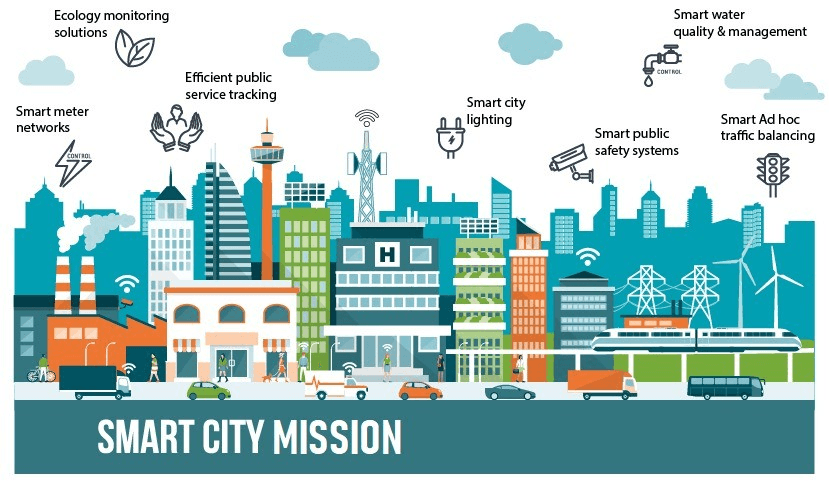
To achieve these goals, cities under the mission are expected to prepare Smart City Proposals (SCPs), which include a mix of Area-Based Development (ABD) and Pan-City Development initiatives. ABD focuses on retrofitting, redevelopment, or greenfield development in a selected area, while Pan-City Development applies smart solutions across the entire city, leveraging technology for traffic management, water supply monitoring, pollution control, and more.
Progress Made So Far
Since its launch, the Smart Cities Mission has made measurable progress in various areas. As of 2025, over 100 cities have been selected for development, with funding support from the central government and state governments. These cities have undertaken projects such as:
- Smart Traffic Management: Implementation of intelligent traffic systems, CCTV monitoring, adaptive traffic signals, and integrated command centers to reduce congestion and improve road safety.
- Digital Citizen Services: Introduction of mobile applications and online platforms for paying utility bills, lodging complaints, accessing health services, and obtaining permits.
- Urban Mobility Improvements: Development of metro networks, bus rapid transit systems, and non-motorized transport lanes to enhance connectivity and reduce pollution.
- Water and Waste Management: Smart metering for water supply, sewage treatment plants, and solid waste segregation initiatives to improve resource efficiency.
- Renewable Energy Integration: Installation of solar panels, energy-efficient street lighting, and promotion of sustainable building practices.
Several cities, including Pune, Bhubaneswar, Surat, and Kochi, have been cited as success stories, demonstrating the potential of smart city interventions to improve urban living. Public-private partnerships (PPP) have played a key role in financing and executing projects, bringing in technology expertise, operational efficiency, and innovative solutions.

Challenges in Implementation
Despite these achievements, the Smart Cities Mission faces several challenges that have slowed progress and limited its impact in some areas:
- Funding Constraints: While the government provides financial support, many projects rely heavily on PPPs, which can be complex to negotiate and implement. Insufficient funding or delays in approvals often hamper timely execution.
- Capacity and Skill Gaps: Urban local bodies (ULBs) often lack the technical expertise, skilled workforce, and administrative capacity to plan, implement, and maintain smart city projects effectively.
- Integration and Interoperability Issues: Diverse systems, technology platforms, and legacy infrastructure in cities create challenges for integration, making it difficult to achieve seamless smart solutions across sectors.
- Land Acquisition and Legal Hurdles: Redevelopment or greenfield projects require land acquisition and compliance with regulations, which can lead to delays and public resistance.
- Citizen Participation: Lack of awareness, engagement, and inclusivity can limit the adoption and effectiveness of smart city initiatives. Without active participation, the benefits of digital governance and citizen-centric services may not reach intended populations.
- Sustainability Concerns: While technology can optimize resources, long-term sustainability depends on careful planning, ongoing maintenance, and environmental considerations, which are sometimes overlooked during project execution.
Addressing these challenges requires robust policy frameworks, capacity-building initiatives, greater transparency, and continuous monitoring to ensure that smart city projects deliver the intended benefits.
Future Outlook and Strategic Directions
The Smart Cities Mission is expected to continue evolving with a focus on scalability, sustainability, and inclusivity. Key areas for future development include:
- Enhanced Data-Driven Governance: Cities will increasingly rely on big data analytics, AI, and IoT to monitor urban systems, predict issues, and optimize resource allocation.
- Green and Resilient Cities: Emphasis on renewable energy, green spaces, climate-resilient infrastructure, and low-carbon urban mobility will be central to future planning.
- Inclusive Urbanization: Smart city initiatives will aim to address the needs of marginalized communities, providing affordable housing, accessible healthcare, and digital literacy programs.
- Public-Private Collaboration: Strengthening PPP models and incentivizing private sector participation will ensure sustainable financing and technology-driven innovation.
- Citizen Engagement: Expanding digital platforms, community outreach, and participatory planning will improve transparency, accountability, and user adoption of smart services.
By aligning technology, urban planning, and citizen needs, India’s smart cities can serve as models for sustainable urban development globally. Successful implementation will require coordinated efforts across central and state governments, urban local bodies, private players, and civil society.

Conclusion / Final Thoughts
The Smart Cities Mission represents a bold and transformative effort to modernize urban India. While notable progress has been made in infrastructure development, digital governance, sustainable urbanization, and citizen services, the mission still faces challenges related to funding, capacity, integration, and inclusivity. Addressing these hurdles is critical to realizing the full potential of smart cities. Looking forward, leveraging technology, fostering public-private partnerships, and engaging citizens will be key to building cities that are not only efficient and sustainable but also equitable and livable. India’s smart cities have the potential to become benchmarks for urban innovation, providing enhanced quality of life and supporting economic growth in the 21st century.
FAQs
1. What is the main goal of India’s Smart Cities Mission?
The mission aims to develop urban areas that are technologically advanced, sustainable, efficient, and citizen-friendly, enhancing quality of life and promoting economic growth.
2. How are smart cities funded in India?
Funding comes from a combination of central and state government allocations, along with public-private partnerships (PPP) for project implementation and innovation.
3. What are some examples of successful smart city projects in India?
Cities like Pune, Bhubaneswar, Surat, and Kochi have implemented smart traffic management, digital citizen services, renewable energy integration, and improved urban mobility successfully.
4. What challenges does the Smart Cities Mission face?
Key challenges include funding constraints, skill gaps in urban local bodies, integration of systems, land acquisition issues, limited citizen engagement, and sustainability concerns.
Next Topic: Regulatory Challenges for Fintech Companies in India
Also Check: Role of AI and IoT in Indian Agriculture