


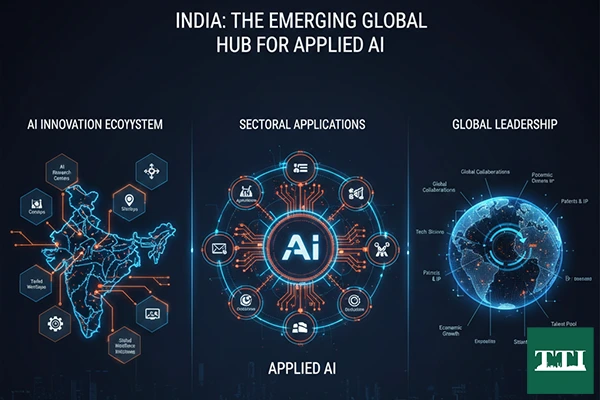
In the rapidly evolving landscape of the “Intelligence Age,” the global race for artificial intelligence dominance is no longer just about who can build the largest foundation models. It is increasingly about who can apply these models to solve real-world problems at scale. While the United States and China lead in capital-intensive research and raw compute power, India is emerging as the global hub for Applied AI.
By leveraging its massive developer ecosystem, a robust $250 billion IT services sector, and a unique “Digital Public Infrastructure” (DPI), India is pivoting from the world’s back office to its foremost “Applied AI factory.”
Why India is Moving Beyond the Foundation Model Arms Race
The development of Large Language Models (LLMs) like GPT-4 or Gemini requires billions of dollars in R&D and massive GPU clusters. Rather than chasing this capital-heavy path, India is focusing on its natural strengths: system-building and implementation.
The Shift from Services to Platforms
India’s $250 billion IT services industry is undergoing a fundamental transformation. Historically rooted in labor arbitrage, these firms are now shifting toward platform-led models. Instead of just providing “man-hours,” they are embedding AI into modular solutions that handle routine enterprise tasks, allowing humans to focus on judgment and compliance.
System-Building at Population Scale
India has a proven track record of building and operating digital systems for hundreds of millions. The “India Stack”—including Aadhaar, UPI, and GSTN—generates datasets that are unmatched in richness and context. These datasets are the fuel for Applied AI, enabling the creation of models that are reliable, scalable, and tailored to complex, real-world environments.
Key Drivers of India’s AI Leadership in 2026
India’s ascent in the AI domain is supported by a “triple threat” of government policy, talent depth, and a thriving startup ecosystem.
1. The IndiaAI Mission and Infrastructure
The Government of India has committed over ₹10,300 crore to the IndiaAI Mission. A critical component of this is the deployment of 38,000 GPUs, providing startups and researchers with affordable access to the high-performance compute needed to build domain-specific applications.
2. A Massive and Growing Talent Pool
India currently accounts for roughly 8% of global AI usage, second only to the US. With over 6 million people employed in the tech ecosystem and the second-largest contributor base to AI projects on GitHub, India’s talent pool is not just large—it is deeply integrated into the global AI workflow.
3. Vertical SaaS and Domain-Specific Copilots
A new generation of Indian founders is focusing on Vertical SaaS—AI solutions built specifically for industries like healthcare, finance, and agriculture. These “domain-specific copilots” are designed to operate under local constraints: low-cost deployment, multilingual accessibility, and strict regulatory compliance.
Read our previous post: Silver Prices in India January 19, 2026: Latest Update & Market Trends
The Power of “Human-in-the-Loop” AI
One of India’s most significant advantages in the Applied AI space is the “Human-in-the-Loop” (HITL) model. Because AI models are stochastic—meaning they can produce “hallucinations” or edge-case errors—pure automation is often risky for critical enterprise processes.
India’s strength lies in platforms where 70%–90% of tasks are automated, while the remaining complex decisions are overseen by human experts. This hybrid approach ensures:
- Reliability: Humans catch errors that models might miss.
- Scalability: Automation handles the bulk of the work, allowing small teams to manage massive operations.
- Trust: Enterprise clients are more likely to adopt AI when there is a clear layer of human accountability.
Applied AI for Social Inclusion and Global Markets
India is defining a unique path for AI leadership that is not dictated by state direction (like China) or pure capital intensity (like the US). Instead, it is defined by entrepreneurship and inclusion.
AI for the Global South
The innovations developed in India—such as AI that works on low-cost devices or in multiple regional languages—are perfectly suited for other emerging markets in Africa, Latin America, and Southeast Asia. India is essentially building the blueprint for “Inclusive AI.”
Leading through Digital Public Goods
Just as UPI revolutionized payments, India is now building affordable, trusted AI platforms for:
- Healthcare: Early diagnosis through AI-powered imaging in rural clinics.
- Education: Personalized learning assistants that speak local dialects.
- Agriculture: Predictive analytics for crop yields and pest control for small-hold farmers.
Challenges and the Path Forward
Despite its rapid progress, India faces hurdles that require a coordinated effort between the government, academia, and industry:
- Compute Constraints: While the IndiaAI Mission is a start, the demand for high-end GPUs still outstrips supply.
- R&D Investment: Private sector investment in core AI research still lags behind global peers.
- Cultural Shift: There is a need for a mindset shift in corporate boardrooms to move from cautious experimentation to full-scale AI integration.
Summary of India’s AI Position (2026)
| Feature | India’s Strategic Advantage |
| Market Role | Global Hub for Applied AI & Export of Intelligence |
| Key Infrastructure | IndiaAI Mission (38,000+ GPUs) & India Stack (DPI) |
| Economic Impact | Projected $1.7 trillion addition to GDP by 2035 |
| Talent Base | 6 million+ tech professionals; top 4 in AI skills globally |
Conclusion: Becoming the World’s Applied AI Factory
India is at a pivotal moment. By productizing its unique advantages—rich data, system-building expertise, and a massive talent pool—the country is transitioning from being the “IT back office” to becoming the “Applied AI factory” for the world. As we move further into 2026, the global success of AI will be measured not just by the intelligence of the models, but by how effectively that intelligence is applied to improve lives and businesses.
Also read: Why Nvidia CEO Jensen Huang Wants Engineers to Stop Coding