


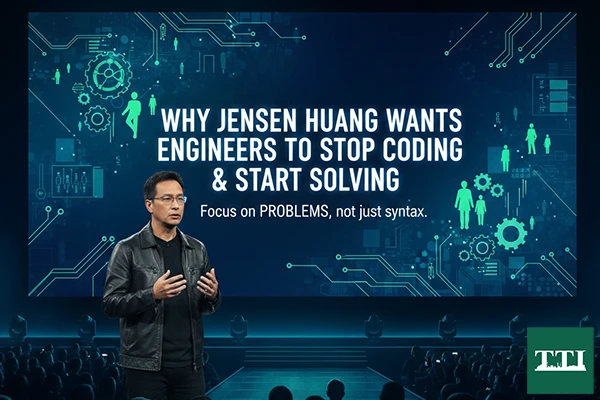
In a move that has sent shockwaves through the Silicon Valley establishment, Nvidia CEO Jensen Huang recently issued a provocative challenge to his engineering teams: stop focusing on writing code and start focusing on “undiscovered problems.”
For decades, the ability to write code—the “syntax” of technology—was the golden ticket to a successful career. However, Huang argues that the rise of generative AI has fundamentally shifted the value proposition of a modern engineer. At a time when AI assistants are writing upwards of 30% to 90% of code at major tech firms like Google and Anthropic, Huang’s vision isn’t just a prediction; it’s a mandate for the next era of computing.
The “Purpose vs. Task” Framework
At the heart of Huang’s philosophy is a clear distinction between tasks and purpose.
In his view, coding is a task—a mechanical process of translating human intent into machine-readable language. The purpose, however, is the actual problem-solving: identifying a bottleneck in a supply chain, designing a more efficient chip architecture, or discovering a new protein structure for medicine.
Why Syntax is Becoming Obsolete
Huang famously stated at the World Government Summit that the “programming language of the future is human.” By leveraging AI tools like Cursor (which Nvidia engineers now use daily), the barrier between an idea and its execution is evaporating.
- Traditional Coding: Requires years of learning specific languages ($C++$, Python, Java).
- AI-Driven Engineering: Requires the ability to articulate complex logic and requirements in natural language.
The Radiology Parallel: Why Jobs Won’t Vanish
One of the biggest fears surrounding Huang’s “death of coding” narrative is mass unemployment for software developers. To counter this, Huang often points to the field of radiology.
When AI first began analyzing medical scans, experts predicted the end of human radiologists. Instead, the number of radiologists grew. Why? Because reading the scan was merely a task. The purpose—diagnosing the patient and managing treatment—became more valuable once the grunt work was automated.
Lessons for Software Engineers
- Increased Demand: As the cost of generating code drops to near zero, the volume of software being built will explode.
- Higher-Level Focus: Engineers will shift from “builders of lines” to “architects of systems.”
- Domain Expertise: Knowledge of biology, physics, or finance will become just as important as knowing how a computer works.
Read our previous post: India: The Emerging Global Hub for Applied AI
The Rise of “Vibe Coding” and Its Risks
While Huang is bullish on a code-free future, the industry remains divided. The term “vibe coding”—coined by former Tesla AI Director Andrej Karpathy—refers to a style of development where a programmer simply “vibes” with an AI until it produces something that works, without necessarily understanding the underlying code.
The Dangers of the “Black Box”
Critics, including Cursor CEO Michael Truell, warn that relying entirely on AI can lead to “shaky foundations.” If an engineer doesn’t understand the code being generated, they cannot effectively:
- Debug complex edge cases.
- Ensure long-term security.
- Optimize for extreme performance.
“If you close your eyes and don’t look at the code… things start to kind of crumble.” — Michael Truell, CEO of Cursor
How to Stay Relevant in the Age of AI
If you are an aspiring engineer or a seasoned developer, the message from Nvidia’s leadership is clear: upskill or be left behind. The “new” engineering toolkit is less about memorizing APIs and more about mastering the following:
1. Problem Discovery
The most valuable people in an AI-driven company are those who can find a problem that no one else has noticed. This requires curiosity and a deep understanding of the “user’s pain.”
2. Prompt Engineering and Logic
While “prompt engineering” is often mocked, the ability to give precise, unambiguous instructions to a Large Language Model (LLM) is a form of high-level programming. It requires a mastery of logic and system constraints.
3. System Architecture
AI is excellent at writing functions, but it still struggles with massive, multi-layered system architectures. Understanding how different pieces of a digital ecosystem fit together remains a uniquely human strength.
Conclusion: The Democratization of Technology
Jensen Huang’s directive to “stop coding” isn’t about devaluing the work of engineers; it’s about democratizing the power of creation. If anyone can “program” using their native language, the “technology divide” that has existed for decades disappears.
In this new world, the winners won’t be those who can type the fastest or remember the most syntax. They will be the ones with the best ideas and the most profound understanding of the problems worth solving.
Also read: Caution is the Mantra: Navigating the Digital World Safely in 2026