


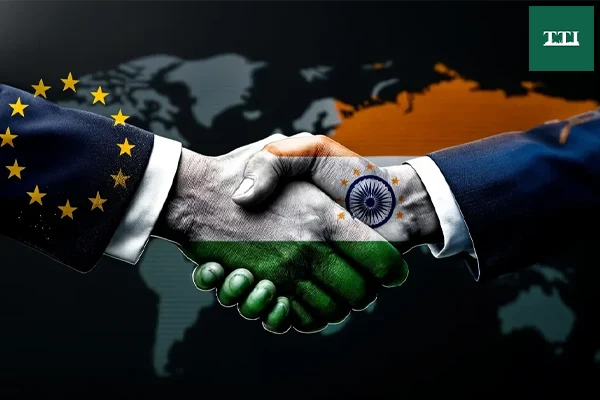
The contemporary geopolitical landscape is currently undergoing a period of profound transformation, marked by shifting alliances and economic friction. In this context, External Affairs Minister S. Jaishankar’s recent diplomatic mission to Paris serves as a pivotal moment for Indian foreign policy. By engaging deeply with French Foreign Minister Jean-Noël Barrot, Jaishankar underscored a strategic pivot: the necessity of a robust India-Europe partnership to act as a stabilizing force in an increasingly fractured world.
The backdrop of these discussions is one of “considerable global uncertainty.” Recent weeks have seen the international order rattled by significant events, including the fallout from United States military operations in Venezuela and the resulting concerns over sovereignty and international law. Simultaneously, New Delhi is navigating a complex trade environment following the imposition of substantial tariffs by Washington. In this “factitious geopolitical environment,” India is looking toward Europe not merely as a market, but as a primary strategic pillar.
A Conscious Choice for Growth and Stability
The decision to prioritize European engagement at this juncture is neither accidental nor reactionary. Addressing the media in Paris, Jaishankar clarified the deliberate nature of this diplomatic outreach. “I think it was a very conscious choice. It was a choice which reflected our belief that this relationship with Europe is really poised to grow, grow to the next level,” he remarked. This “next level” transcends traditional trade, aiming instead for a comprehensive integration of security, technology, and governance.
Jaishankar’s presence in Europe is a testament to the belief that the continent remains an indispensable actor on the world stage. He noted, “Because I think Europe is such an important player in global politics, it is also necessary that India strengthens its relationship (with it).” The logic is clear: in a world where unilateralism is on the rise, the collaboration between the world’s largest democracy and the European collective offers a necessary counterweight. Together, these two powers aim to inject a sense of predictability into the global system. “I think we can bring more stability both into the international economy and global politics. And that really is why I am here,” Jaishankar added.
Also Read: ‘Darkest day of my life’: Vedanta chairman Anil Agarwal after son dies in skiing accident
Substantive Cooperation Beyond Diplomacy
While the rhetoric emphasizes stability, the foundation of the India-Europe relationship is built on a very tangible and “substantive” set of interests. The dialogue in Paris touched upon several critical sectors that are essential for future-ready economies. India and Europe are currently negotiating a Free Trade Agreement (FTA) that promises to redefine their economic ties, but the cooperation extends far into the realms of high technology and infrastructure.
The Minister highlighted that recent internal discussions in India have focused heavily on semiconductors, railways, defense, and aviation—all areas where European expertise and Indian scale create a natural synergy. This technical cooperation is not just about commerce; it is about building resilient supply chains that are less susceptible to the whims of any single global power. “So there is really a very substantive relationship, much more that can be done. But other than that, I think there is a larger discussion today that the world needs about the global order,” Jaishankar stated, bridging the gap between practical industrial cooperation and high-level global strategy.
Navigating the Future of the Global Order
Central to the discussions was the question of what the future international framework should look like. As traditional norms are challenged, India and France, in particular, are positioning themselves as defenders of a multipolar world. Jaishankar’s visit was partly to prepare the ground for President Emmanuel Macron’s upcoming visit to India for the AI Summit, an event that will likely set the tone for ethical governance in emerging technologies.
With India chairing BRICS and France helming the G7 this year, the two nations occupy unique vantage points in the global hierarchy. Their participation in the G20 further cements their role as mediators between the Global North and the Global South. “So as two nations committed to multi-polarity, I believe that working together is important for ourselves, also for stabilising the global politics at this stage,” Jaishankar explained. He further emphasized the longevity and depth of the bilateral bond, noting that “France is amongst our oldest strategic partners, the first in Europe, and I believe that our continuous conversation is an important part of nurturing that relationship.”
A Season of High-Level Engagement
The diplomatic calendar suggests that the coming months will see a significant intensification of these ties. India is preparing to host a succession of high-profile European leaders, signaling a “European Spring” in Indian diplomacy. “I should add, by the way, as soon as I get back that we would be expecting to welcome Chancellor Merz in India. And as I said, soon, President Macron will be there. A number of other European leaders are also slated to visit India very shortly,” Jaishankar confirmed.
The visit of German Chancellor Friedrich Merz, alongside President Macron and top EU officials, represents a collective European effort to engage with India on issues ranging from green energy transitions to maritime security in the Indo-Pacific. As the world asks, “What kind of world do we want to live in? What would be the norms and the other related issues?”, the answer may very well be found in the strengthening corridor between New Delhi, Paris, and Berlin. By aligning their visions, India and Europe are not just reacting to global instability—they are actively working to design a more balanced and cooperative global order.
Also Read: Schoolgirl gangraped in Kanpur; YouTuber nabbed, hunt on for cop