


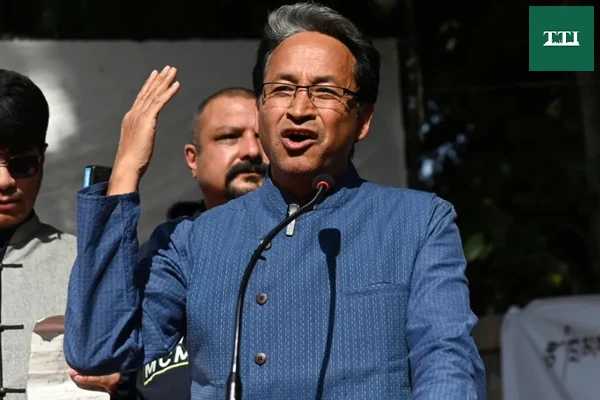
The Supreme Court of India has formally deferred the hearing regarding the detention of renowned climate activist and educator Sonam Wangchuk by twenty-four hours. On Wednesday, January 7, 2026, the Division Bench, presided over by Justice Aravind Kumar, announced the one-day adjournment to ensure a thorough judicial review of the case materials. The delay was primarily granted to enable Justice P.B. Varale—the puisne judge on the bench—to fully acquaint himself with the voluminous case records and the complex legal history surrounding the detention.
This procedural shift follows a change in the Bench’s composition. Prior to the court’s winter recess, the matter was being heard by a Bench comprising Justices Kumar and N.V. Anjaria. However, as the court resumed its sessions, Justice Varale replaced Justice Anjaria, necessitating a brief pause to maintain the integrity of the judicial process.
The Backdrop of the Detention
The legal battle stems from a challenge launched by Dr. Gitanjali J. Angmo against the Central Government’s decision to invoke the National Security Act (NSA), 1980, against her husband. Sonam Wangchuk, a recipient of the Ramon Magsaysay Award known for his environmental work in Ladakh, was detained on September 26, 2025. This action followed a period of civil unrest and violent protests that occurred on September 24 in Leh.
Shortly after his apprehension, Mr. Wangchuk was shifted from Ladakh to the Jodhpur Central Jail in Rajasthan. The move to a high-security facility far from his home region has been a point of significant contention for his legal team and supporters, who view the transfer as an attempt to isolate the activist from his community and legal counsel.
Also Read: Justice for Nikitha Godishala: Family Rejects Relationship Rumors, Alleges Financial Motive
Allegations of Political Interference
In her petition, Dr. Angmo presents a narrative that suggests the detention was less about public order and more about political maneuvering. She alleged that the Ministry of Home Affairs (MHA) had nursed “strong reservations” regarding Mr. Wangchuk’s participation in the High Powered Committee (HPC). This committee, composed of representatives from the Apex Body Leh (ABL) and the Kargil Democratic Alliance (KDA), was formed to engage in critical negotiations with the Union Government over the future of the Union Territory.
The core of these negotiations involves demands for Ladakh’s statehood and the implementation of safeguards under the Sixth Schedule of the Indian Constitution, which provides for autonomous district councils in tribal areas. Dr. Angmo contends that her husband’s detention was a tactical move to weaken the delegation’s leverage during these high-stakes talks.
Denying the “Provocateur” Label
Central to the government’s justification for the NSA charge is the allegation that Mr. Wangchuk played a pivotal role in inciting the violence seen in late September. Dr. Angmo has vehemently denied these claims, characterizing the detaining authority’s actions as having “malicious intent.”
The petition emphasizes that Mr. Wangchuk has consistently advocated for peaceful, constitutional means of protest. Highlighting his history of service, the defense argued:
“The brazen allegation that Mr. Sonam Wangchuk has acted as chief provocateur in the violent protest that took place on 24 September 2025 is false, malicious and fabricated and entirely contrary to the material on record… On the contrary, Mr. Sonam Wangchuk has made significant contributions in support of national security and the Armed Forces.”
This argument seeks to contrast the government’s portrayal of a threat to national security with Mr. Wangchuk’s long-standing public record of supporting the Indian military’s logistical needs in the high-altitude terrain of Ladakh through his architectural and engineering innovations.
Procedural Violations and Section 8 of the NSA
Beyond the merits of the protest itself, the legal challenge focuses heavily on procedural lapses by the detaining authorities. Represented by a high-profile legal team including senior advocates Kapil Sibal and Vivek Tankha, along with advocate Sarvam Ritam Khare, Dr. Angmo argued that the government failed to uphold the statutory requirements of the National Security Act.
According to the defense, there was a “flagrant delay” of 28 days before the complete grounds of detention were finally shared with Mr. Wangchuk, despite his repeated formal representations to his captors. This delay, they argue, is a direct violation of the constitutional and statutory rights afforded to any detainee.
The petition specifically cites Section 8 of the NSA, which outlines the mandatory timeline for communication:
She submitted that Section 8 of the NSA required the detaining authority to share the complete reasons for detention within 10 days to provide the detenue the “earliest opportunity to make an effective representation against the order to the appropriate government”.
The defense maintains that by withholding these grounds for nearly a month, the state effectively stripped Mr. Wangchuk of his right to defend himself in a timely manner, rendering the detention order legally unsustainable.
Looking Ahead
As the Supreme Court prepares to hear the case tomorrow, the eyes of the nation remain on the Bench. The outcome of this hearing will not only decide the immediate fate of Sonam Wangchuk but could also set a significant precedent regarding the use of the National Security Act against civil rights activists and the strictness with which the judiciary enforces the procedural timelines of preventive detention laws.
Also Read: Coach Accused of Sexually Assaulting National-Level Shooter: Investigation Underway in Faridabad