


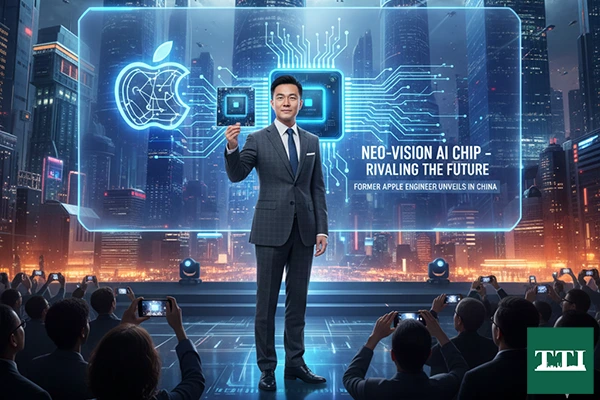
In a move that signals a seismic shift in the global extended reality (XR) landscape, a former Apple engineer has unveiled a groundbreaking AI chip designed to outperform the technology powering the Apple Vision Pro. Wang Chaohao, a veteran of Apple’s specialized XR division and a Stanford University graduate, is now leading GravityXR, a Chinese startup that is quickly becoming the centerpiece of China’s push for semiconductor self-reliance.
The announcement of the Jizhi G-X100 chip represents more than just a new hardware launch; it is a direct challenge to Apple’s dominance in spatial computing and a testament to the accelerating “brain drain” of Silicon Valley talent toward emerging tech hubs in Asia.
The Jizhi G-X100: A New Benchmark for Mixed Reality
The Jizhi G-X100 is being hailed as China’s first all-in-one mixed reality (MR) chip built on an advanced 5-nanometer (5nm) process. Designed to power everything from lightweight AI smart glasses to professional-grade XR headsets, the chip aims to solve the technical bottlenecks that have long hindered the mass adoption of wearable spatial computers.
Breaking the Latency Barrier
Perhaps the most significant claim made by GravityXR is the chip’s performance in photon-to-photon (PTP) latency. In the world of augmented and mixed reality, PTP latency refers to the time it takes for an image to be captured by a camera, processed by a chip, and displayed to the user’s eyes.
- Apple Vision Pro: 12 milliseconds (ms)
- Jizhi G-X100: 9 milliseconds (ms)
While a 3-millisecond difference may seem negligible, it is a critical threshold in spatial computing. Lower latency reduces “motion-to-photon” lag, which is the primary cause of motion sickness and disorientation in XR environments. By hitting the 9ms mark, GravityXR claims to offer a more seamless, responsive, and comfortable user experience than the current industry leader.
Why This Matters for the XR Industry
The emergence of the Jizhi G-X100 comes at a time when the “spatial computing” race is heating up. While Apple has focused on high-end, heavy-compute devices, the market is pivoting toward wearable AI.
1. Enabling Lightweight AI Glasses
One of the core advantages of the G-X100 is its power efficiency. High-performance chips typically require bulky cooling systems and large batteries, which is why the Vision Pro is often criticized for its weight. GravityXR’s 5nm architecture is designed to enable AI glasses that weigh less than 100 grams, making them viable for all-day wear rather than short sessions.
2. Strategic Independence
For China, this chip is a major victory in its quest for technological sovereignty. Amid ongoing trade tensions and U.S. export controls on high-end semiconductors, having a homegrown alternative to Apple’s R1 and M-series chips is vital. The project has received early support from the Yongjiang Lab in Ningbo, a government-backed facility that identified spatial computing as a “significant breakthrough” area for national tech interests.
GravityXR: The Startup Powerhouse
GravityXR isn’t just a small operation; it is backed by some of the most influential names in venture capital and manufacturing.
- Investors: The startup has secured funding from HongShan (formerly Sequoia Capital China), Gaorong Capital, and miHoYo (the developer behind the global hit Genshin Impact).
- Manufacturing Partners: Reports suggest that Goertek, a major contract manufacturer that has previously worked with Apple and Meta, is both an investor and a potential client.
This combination of elite engineering talent and deep-pocketed institutional support suggests that GravityXR is positioned for rapid scale-up.
The “Apple-to-China” Talent Shift
Wang Chaohao’s departure from Apple to found a rival in China reflects a broader trend. Over the last few years, several high-ranking engineers and researchers have left U.S. tech giants to lead ambitious projects in their home countries.
This migration of expertise is often referred to as the “Reverse Brain Drain.” These engineers bring with them years of experience in product design, supply chain management, and hardware-software integration—the very secrets that made Apple the most valuable company in the world.
Challenges Ahead: Can It Truly Beat Apple?
While the technical specs of the Jizhi G-X100 are impressive, raw chip power is only one piece of the puzzle. To truly rival the Apple Vision Pro, GravityXR and its partners must overcome several hurdles:
- Software Ecosystem: Apple’s visionOS benefits from a massive developer community and seamless integration with the iPhone/Mac ecosystem.
- Standardization: It is currently unclear if the G-X100 will support OpenXR, the industry standard that allows developers to port apps easily across different hardware. Without this, global adoption might be slow.
- Production Volume: While the design is ready, securing capacity at high-end foundries like TSMC or Samsung is difficult, especially as demand for AI chips from Nvidia and Apple remains at an all-time high.
The Future of Spatial Computing
The Jizhi G-X100 is a clear signal that the next phase of the XR war will be fought on the battlefield of silicon. As companies like GravityXR push the boundaries of latency and power efficiency, consumers can expect a new wave of devices that are lighter, faster, and more affordable.
Whether GravityXR can dethrone Apple remains to be seen, but one thing is certain: the competition in spatial computing has officially gone global.