


The rapid ascent of India’s online gaming industry has met a staggering legal roadblock. In a high-profile crackdown on the real-money gaming (RMG) sector, the Enforcement Directorate (ED) has filed a comprehensive chargesheet against WinZO, one of India’s most popular gaming platforms.
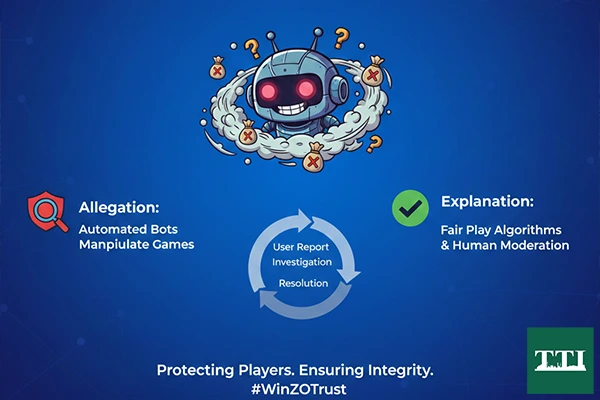
The central agency alleges a systematic fraud involving the deployment of artificial intelligence and bots to manipulate game outcomes, leading to a staggering ₹734 crore loss for unsuspecting players. This case serves as a landmark moment in India’s regulatory battle against unethical practices in the digital gaming space.
The Core Allegation: “Human vs. Machine” in Disguise
At the heart of the ED’s prosecution complaint, filed before a special court in Bengaluru, is the claim that WinZO knowingly deceived its 25 crore users. While the platform marketed itself as a “fair and transparent” arena for human-to-human competition, the investigation paints a far more mechanical picture.
The Use of “Persona” and “EP”
According to the ED, WinZO’s internal systems were embedded with algorithms referred to by misleading terminologies like EP (Engagement Play), PPP (Past Performance of Player), and Persona. These were not just technical features but were allegedly used to simulate human behavior.
- Algorithm-Driven Profiles: Until December 2023, the ED claims WinZO used “hard-coded” bots to play against users.
- Historical Data Manipulation: From May 2024 until the government ban on RMGs in August 2025, the tactic shifted. The app allegedly used historical gameplay data from inactive or dormant accounts to simulate “live” matches against real users without their consent.
The Modus Operandi: The “Lure and Drain” Strategy
The ED’s findings detail a calculated psychological strategy designed to maximize user spending before systematically draining their wallets.
1. Building a False Sense of Trust
The investigation revealed that new users were initially “lured” with small signup bonuses. In their early games, they were matched against “easy bots,” allowing them to win frequently. By permitting users to withdraw these small winnings, WinZO allegedly created a false sense of security and trust in the platform’s fairness.
2. Escalating Stakes and “Hard Bots”
Once a player gained confidence and began betting larger sums—referred to as “higher boot amounts”—the system would deploy “hard bots.” These AI-controlled opponents were reportedly nearly impossible to beat at high stakes, ensuring that the lion’s share of the money remained with the platform.
3. Restrictive Withdrawals
Even when genuine players managed to win at high stakes, the ED alleges that WinZO used restrictive withdrawal mechanisms to block their funds. This effectively forced users to keep playing with their winnings until they eventually lost them back to the platform’s algorithms.
Financial Impact: Proceeds of Crime and Global Laundering
The scale of the alleged fraud is immense, reaching deep into the pockets of users from Tier-3 and Tier-4 cities who were often in search of quick financial gains.
- Proceeds of Crime (PoC): The ED estimates that WinZO generated a total of ₹3,522.05 crore in proceeds of crime between the 2021-22 and 2025-26 financial years.
- User Financial Distress: The manipulative structure reportedly caused severe financial hardship. The ED’s report even noted instances of “extreme mental distress” and suicidal tendencies among players who lost their life savings to the app.
- Offshore Diversion: A significant portion of these funds—approximately USD 54 million (₹480+ crore)—was allegedly laundered and parked in shell companies in the United States and Singapore. The ED identified “WinZO US Inc.” as a shell entity controlled entirely from India.
Regulatory Context: The 2025 Real-Money Gaming Ban
This chargesheet comes in the wake of the Union government’s decisive move to ban real-money gaming apps in August 2025. Despite this ban, the ED alleges that WinZO failed to return nearly ₹47.66 crore in legitimate user winnings and deposits, continuing to hold onto player funds illegally.
The directors of WinZO, Paavan Nanda and Saumya Singh Rathore, have both been named as primary accused in the chargesheet. While the company has previously defended its “social gaming” model, the ED’s evidence—extracted from seized electronic devices and internal codebases—suggests a deep-seated culture of algorithmic manipulation.
Conclusion: A Wake-Up Call for the Gaming Industry
The WinZO case marks a turning point for digital ethics in India. As the government tightens its grip on the “gambling-under-the-guise-of-gaming” sector, the allegations of bot manipulation serve as a warning to both developers and users.
For millions of gamers, this investigation highlights the hidden risks of digital platforms where the opponent might not be a person, but a profit-driven algorithm. As the case moves through the PMLA (Prevention of Money Laundering Act) court, the outcome will likely dictate the future of digital consumer protection and the legal boundaries of AI in the entertainment industry.