


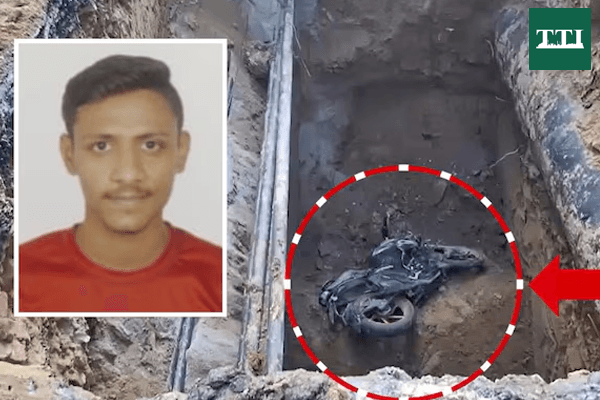
In a tragic incident that has once again highlighted the perilous state of urban infrastructure in the national capital, a 25-year-old man lost his life after falling into an open Delhi Jal Board (DJB) pit in West Delhi’s Janakpuri area. The victim, identified as Kamal, was a resident of the Kailashpuri neighborhood and worked at an HDFC Bank call center in Rohini. His body was recovered on the morning of Friday, February 6, 2026, following a frantic overnight search by his family and friends.
The Fatal Incident and Overnight Search
Kamal was returning home from work on his motorcycle late Thursday night when the accident occurred. According to his family, he had reached the District Centre area and was barely 15 minutes away from home when he went missing. When he failed to arrive and stopped answering his phone, his family grew concerned and launched a search.
His friends and relatives spent the entire night scouring the area and visiting multiple police stations across West Delhi to report his disappearance. Despite their efforts, they received little immediate assistance. In a heartbreaking twist, the family revealed that they had actually checked the vicinity of the construction site around 1:00 AM but did not see him at that time. It was only at 7:00 AM on Friday morning that the police informed them that Kamal’s body, still wearing his helmet, and his mud-smeared motorcycle had been discovered at the bottom of the deep pit.
Also Read: Delhi Police: Paid Promos Fueling Fake “Missing Girls” Surge Reports
Allegations of Negligence and Lack of Safety
The incident has sparked widespread outrage, with the victim’s family and local residents alleging gross negligence on the part of the Delhi Jal Board and the construction contractors. The pit, located on Joginder Singh Marg near Green Valley Apartments, was reportedly part of an ongoing project to lay water pipelines.
While senior police officials claimed the site was “properly barricaded,” eyewitnesses and the victim’s friends disputed this, stating that the area lacked adequate warning signs, reflectors, or proper lighting to alert commuters in the dark. The tragedy is being viewed as a “preventable death trap.” Local Residents’ Welfare Associations (RWAs) claimed they had repeatedly complained to authorities about the hazardous condition of the dug-up road, but no corrective action was taken until a life was lost.
Political Fallout and Investigation
The death has quickly escalated into a political flashpoint. Senior leaders from various parties visited the site to express condolences and demand accountability. Delhi Minister Ashish Sood ordered an immediate probe into the lapse of safety protocols. He stated that the Jal Board had previously issued circulars regarding safety audits and promised that if any official or contractor is found responsible for the negligence, they “will not be spared.”
Meanwhile, opposition leaders and former MLAs have hit out at the government, questioning why barricades and safety measures were only reinforced after the fatal accident. They highlighted the human cost of such systemic apathy, noting that Kamal was a primary breadwinner for his family, who are now left devastated by the loss.
A Recurring Pattern of Infrastructure Failures
This incident comes on the heels of a similar tragedy in Noida just weeks prior, where a software engineer died after his car fell into a water-filled construction pit. These recurring accidents have brought the focus back to the “death traps” created by unfinished or poorly managed civic projects across the National Capital Region (NCR).
As the Delhi Police register a case and continue their investigation, the community remains in mourning. The case serves as a grim reminder of the urgent need for stricter enforcement of safety standards at construction sites to ensure that no other family has to endure a night of uncertainty ending in such a horrific discovery.
Also Read: The Trillion-Dollar Impact: Redistributing Half the Wealth of the World’s Richest