


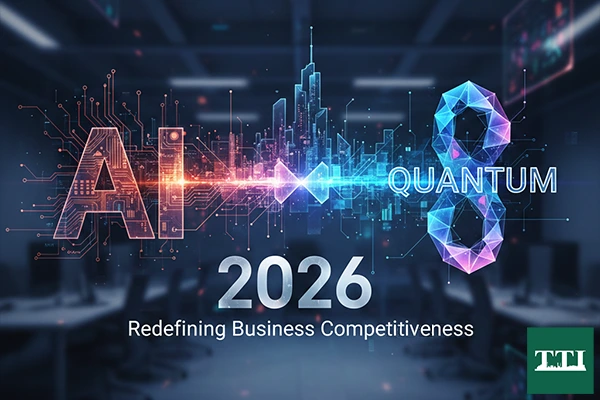
The global business landscape is currently navigating a period of unprecedented change. As of 2026, the convergence of Artificial Intelligence (AI) and Quantum Computing has shifted from a theoretical prospect to a critical driver of market leadership. A recent report by Metro India highlights how these “dual pillars” of innovation are no longer just optional upgrades but essential survival tools for modern enterprises.
The Synergy of AI and Quantum: A New Competitive Era
Individually, AI and Quantum technologies are revolutionary. However, their true power lies in their synergy. AI excels at finding patterns within massive datasets, while Quantum computing provides the raw computational muscle to solve problems that are mathematically “intractable” for classical computers.
Understanding the Convergence
When AI algorithms are powered by quantum hardware, the result is Quantum Machine Learning (QML). This fusion allows for:
- Faster Training Cycles: Reducing the time to train complex neural networks from weeks to seconds.
- High-Dimensional Data Analysis: Processing thousands of variables simultaneously to identify correlations that classical AI would miss.
- Enhanced Precision: Achieving near-perfect accuracy in predictive modeling.
How Quantum-AI is Redefining Key Industries
The impact of these technologies is not uniform; it is hitting specific sectors with disruptive force. In 2026, the industries leading the charge include finance, healthcare, and logistics.
1. Finance: Real-Time Risk and Portfolio Management
In the financial sector, “competitive advantage” is often measured in milliseconds. Quantum-enhanced AI is being used to:
- Optimize Portfolios: Rebalancing global assets in real-time based on shifting geopolitical data.
- Detect Fraud: Identifying subtle “ghost” patterns in transactions that indicate sophisticated money laundering.
- Price Derivatives: Solving the Black-Scholes model for complex financial instruments at speeds previously thought impossible.
2. Healthcare and Pharmaceuticals: Accelerated Discovery
The traditional drug discovery process—which once took a decade—is being compressed.
- Molecular Simulation: Quantum computers can simulate the behavior of atoms and molecules at a level of detail that classical systems cannot.
- Personalized Medicine: AI analyzes a patient’s unique genetic code to tailor treatments, while Quantum processors handle the massive genomic datasets required for such precision.
3. Logistics and Supply Chain: The End of Inefficiency
Global supply chains are notoriously complex. Quantum-AI allows companies to:
- Solve the “Traveling Salesperson” Problem: Calculating the absolute most efficient route for thousands of delivery vehicles simultaneously.
- Predictive Maintenance: AI sensors on machinery predict failure, while Quantum models simulate the impact of that failure across the entire production line.
Why 2026 is the “Quantum Tipping Point”
For years, Quantum computing was relegated to the “five years away” category. However, 2026 has seen several key milestones that have moved the needle.
Practical Milestones and “Quantum Supremacy”
Companies like Google, IBM, and Rigetti (which recently delivered a 108-qubit system to India’s C-DAC) have moved beyond laboratory prototypes. We are now seeing “Applied Quantum Computing,” where businesses use hybrid cloud systems to access quantum power via the API.
India’s Strategic Role
India has emerged as a global hub for these technologies. Through the National Quantum Mission, the Indian government is fostering a “Quantum-Ready” workforce. With centers of excellence in cities like Bengaluru and Mumbai, Indian startups are now competing on the global stage, developing sovereign AI models and quantum-secure communication protocols.
The Strategic Roadmap for Business Leaders
To remain competitive in this redefined landscape, business leaders must move beyond the “wait-and-see” approach. The Metro India article underscores several strategic imperatives:
Investing in Talent
There is a global shortage of engineers who understand both AI and quantum mechanics. Companies are now focusing on:
- Upskilling: Training existing AI developers in quantum-native languages like Qiskit or Cirq.
- Interdisciplinary Teams: Breaking down silos between data scientists, physicists, and business analysts.
Preparing for “Q-Day” (Post-Quantum Cybersecurity)
As quantum computers become more powerful, they will eventually be able to break current encryption standards. Forward-thinking businesses are already transitioning to Post-Quantum Cryptography (PQC) to protect their data from future threats.
| Technology Component | Current Impact (2026) | Future Outlook (2030+) |
| Generative AI | Mainstream productivity tool | Autonomous agent-based ecosystems |
| Quantum Annealing | Optimization & Logistics | Real-time global supply chain autonomy |
| Gate-Model Quantum | Early error correction; pilot programs | Large-scale chemical/material simulation |
| Quantum AI (QML) | Emerging competitive edge | Standard architecture for all enterprise AI |
Ethical and Governance Challenges
With great power comes the need for robust governance. The rapid rise of Quantum-AI has sparked urgent discussions about:
- Transparency: Quantum processes are probabilistic, making “Explainable AI” even more difficult to achieve.
- Digital Divide: The high cost of quantum hardware risks creating a gap between “tech-rich” and “tech-poor” nations.
- Sustainability: While Quantum-AI is more energy-efficient in terms of calculations per watt, the cryogenic infrastructure required to cool these chips remains an environmental challenge.
Conclusion: The Competitive Imperative
The link between technology and business competitiveness has never been more direct. As highlighted by Metro India, the integration of AI and Quantum technologies is creating a new hierarchy in the corporate world. The winners of the next decade will be those who can harness the “Thinking Power” of AI and the “Processing Strength” of Quantum to solve the world’s most complex problems.
The window for experimentation is closing. The era of implementation has begun.