


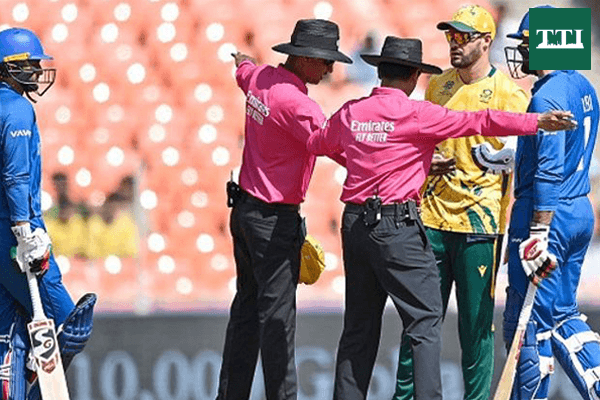
In a tournament that has already delivered high-stakes drama and nail-biting finishes, the ICC Men’s T20 World Cup 2026 recently witnessed a disciplinary intervention following one of its most intense fixtures. Veteran Afghanistan all-rounder Mohammad Nabi has been officially sanctioned by the International Cricket Council (ICC) for a breach of the Code of Conduct during a high-octane Group D clash against South Africa at the Narendra Modi Stadium in Ahmedabad.
The Incident in Ahmedabad
The incident unfolded during the heat of the 14th over of Afghanistan’s innings on Wednesday, February 11. Nabi, a cornerstone of the Afghan lineup, became embroiled in a sustained and heated argument with the match officials. The point of contention was a wristband worn by South African pacer Lungi Ngidi. Nabi expressed visible frustration, suggesting that the color or nature of the equipment was interfering with the batters’ ability to pick the ball clearly.
Despite repeated instructions from the umpires to resume play and move past the grievance, the former Afghanistan captain continued to contest the matter. This refusal to adhere to the officials’ directives led to a significant delay in the match, which eventually concluded in a historic double Super Over thriller.
Also Read: Italy’s Historic Breakthrough and Co-Host Dominance at T20 World Cup 2026
Official Charges and Breach
Following an assessment by the match officials, Nabi was found to have breached Article 2.4 of the ICC Code of Conduct for Players and Player Support Personnel. This specific article pertains to “Disobeying an Umpire’s instruction during an International Match.”
The charges were formally leveled by the officiating crew present at the Ahmedabad fixture. The team of officials included on-field umpires Jayaraman Madanagopal and Sharfuddoula Ibne Shahid, supported by third umpire Nitin Menon and fourth umpire K.N. Ananthapadmanabhan. Because the breach was categorized as a Level 1 offense, it carried a set range of penalties designed to maintain the integrity and flow of the game.
Sanctions and Penalties Imposed
As a result of the breach, the ICC imposed a fine equivalent to 15 percent of Mohammad Nabi’s match fee. In addition to the financial penalty, the all-rounder has been handed one demerit point, which has been added to his disciplinary record. This represents Nabi’s first offense within the current 24-month period.
Under the ICC’s disciplinary system, demerit points remain on a player’s record for two years. If a player reaches a certain threshold—specifically four or more demerit points within that 24-month window—they are converted into suspension points, which can lead to a ban from subsequent international matches. In this instance, Nabi admitted to the offense and accepted the sanction proposed by David Gilbert of the Emirates ICC International Panel of Match Referees. His admission meant that a formal hearing was not required, allowing the tournament to proceed without further legal proceedings.
Impact on Afghanistan’s World Cup Campaign
The sanction adds a layer of difficulty to what was already a heartbreaking night for the Afghan squad. The match against South Africa was a rollercoaster that saw both teams finish their 20 overs tied at 187 runs. The tension escalated through a first Super Over that remained deadlocked, finally ending in the second Super Over when South Africa secured a narrow victory.
While the fine and demerit point are relatively minor in the immediate term, they serve as a stern reminder of the ICC’s commitment to player conduct, especially in high-pressure environments. For Afghanistan, the loss and the subsequent disciplinary action against a senior player come at a critical juncture. With two consecutive defeats in the group stage, the team now faces an uphill battle to secure a spot in the Super 8 stage.
Looking Ahead
As the tournament moves forward, Afghanistan will need to pivot their focus toward their upcoming fixture against the UAE in Delhi on February 16. The team’s management and coaching staff, including Jonathan Trott, will likely emphasize the importance of maintaining on-field composure to ensure that external distractions do not derail their tactical execution.
For Nabi, the veteran’s experience will be vital in helping the younger players navigate the pressure of a World Cup. However, he will now have to play with the awareness of his current disciplinary status, ensuring that future interactions with officials remain within the boundaries of the ICC’s Code of Conduct. As the 2026 T20 World Cup continues to captivate global audiences, this incident stands as a testament to the intensity of modern international cricket and the thin line between competitive passion and professional misconduct.
Also Read: The Blue Revolution: Italy’s Cricketing Ambitions Expand After Historic T20 World Cup Win